

The policy manual,
read the way litigation reads it.
Direct line: (239) 571-1840 · GregoryGilbertson@proton.me
Attorney and law-firm inquiries only
An agency’s policy manual is a document counsel can measure against. It is also a document that changes, gets superseded, and is trained unevenly. This guide covers what to request, how a practices analysis reads what arrives, and the difference between a policy that existed and a policy that governed anything.
Three experts. Over 110 years.
Professor Gregory Gilbertson (Ret.), FBI Special Agent Christopher Holland (Ret.), and Sheriff Robert Snaza consult with attorneys nationwide regarding police practices and procedures, use of force, false arrest, police misconduct, criminal, and self-defense casework.
 CEO & Owner
Thirty-eight years in four uniforms: street cop, soldier, professor, investigator. More than 220 matters in 42 states and D.C. since 2014.
Full biography Consultant
More than thirty-five years in public safety: Sheriff of Lewis County, Washington, since his election in 2015, and six years as a commissioner of the state board that sets peace-officer training standards.
Full profile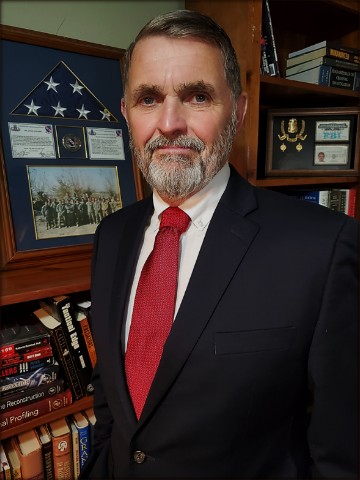 Consultant
Forty years of investigative casework, from patrolman in St. Louis County to the FBI in Chicago, and on to task forces in Afghanistan and Liberia. His work on the Idaho student murders is examined in Broken Plea, the New York Times bestseller by Christopher Whitcomb.
Full profileThe Hon. Richard A. Jones United States District Judge“Mr. Gilbertson’s qualifications demonstrate extensive experience in policing. His expansive work as a police officer in Georgia, with assignments as a SWAT team officer, juvenile court investigator, school resource officer, stakeout squad officer, senior patrolman, and patrolman; then a career as a tenured college professor and university lecturer teaching criminal justice courses to degree-seeking students at colleges and universities, and as a licensed private investigator conducting felony pretrial investigations for attorneys in Washington State in dozens of criminal cases, makes him unique in the field of police expert witnesses. The Court finds that, based on his experience, Mr. Gilbertson’s testimony can be expected to have a reliable basis in knowledge and experience of police practices.”
What to request, and why the date on it matters.
The first request is narrower than counsel usually expects, and more specific. Not the current manual: the manual in force on the date of the incident, produced with its effective date on its face. Agencies revise continuously, and a manual produced in discovery well after an event is frequently not the document the involved officers were governed by.
The written direction an agency issues also rarely lives in one binder. General orders, special orders, training bulletins and standard operating procedures (SOP) all carry operative rules, and any one of them can modify the manual without the manual changing on its face. Mutual aid agreements matter for the same reason: when officers from more than one agency work an incident, the agreement may say whose rules governed, and where it is silent that silence is itself a finding, because each officer is then left under the manual of the employing agency.
- The policy manual in force on the incident date, produced with its effective and revision dates
- The revision history for each policy at issue, showing what changed and when it changed
- General orders, special orders and directives issued between manual revisions
- Training bulletins and roll-call material interpreting the policies at issue
- Unit SOP documents for the units involved, which are often held separately from the manual
- Mutual aid agreements governing any assisting agency present at the incident
- Distribution and acknowledgment records showing who received which version, and when
The version date is not housekeeping. Revisions tend to follow events. Read in date order, the versions show which incident prompted which change, and that ordering is usually where the notice question is first answered. The date also decides the measuring stick: conduct is compared to the rule in force at the time, never to a rule the agency adopted afterward in response to the very incident at issue.
Ask for the revision history as a separate numbered item, and ask for the effective date on the face of each policy produced. A request for the manual is often answered with the current manual, and the production is technically responsive.
How the manual is actually read.
A policy manual is read one operative sentence at a time, and the reading starts in the definitions chapter. Terms that sound ordinary carry defined meanings inside the manual, and the defined meaning controls. A force policy that authorizes action against an actively resisting subject means nothing until the manual’s own definition of active resistance is placed next to the video.
Mandatory language against discretion.
The most productive line in any manual review separates shall from may. Mandatory language creates a rule an officer either followed or did not, and a supervisor either enforced or did not. Discretionary language creates a decision point, and the review question becomes whether the discretion was exercised within the limits the policy set and documented the way the policy required. Language that announces a goal but never tells an officer what to do creates neither obligation, and the review says so rather than reading a rule into it.
Cross-references, and the rule that lives elsewhere.
Operative rules migrate. A vehicle pursuit chapter may hand the force question to the force chapter, which hands the reporting question to a records chapter, which hands the review question to an administrative order. Following those chains matters because a policy can be adequate in the chapter counsel opened and hollow in the chapter it points at. It matters for a second reason as well: a rule that surfaces only at the end of a chain of cross-references is one no officer on a shift was reading, and that placement is itself a finding.
A policy that exists, and a policy that was trained.
The manual can show a policy was issued and acknowledged, and a review that stops there has answered only part of the question. What the agency actually taught is a separate document set, held by a separate office, and the manual is silent about it. That silence is why a finding about instruction can never be sourced to the manual alone.
Adequacy and compliance are not the same question.
Two distinct questions get collapsed constantly, in briefs and in expert reports, and separating them is most of the discipline of this work. Adequacy is the layer-one question, and the failure modes are catalogued in policy, practice and training: the three layers; this page stays on how the manual is read to answer it. Compliance asks something narrower: whether the officers did what the rule said.
The answers travel independently. An agency can hold a strong, current policy that the involved officers ignored. It can also hold a thin or obsolete policy that the officers followed to the letter, in which case the exposure sits with the agency rather than with the individual. A report that blurs the two produces findings that come apart under examination, because opposing counsel only has to ask which question the witness is answering.
- Adequacy: whether the rule itself measured up, read the way the three-layers brief sets out
- Compliance: did the documented conduct follow the rule as it was written
- Compliance: did supervisors do what the policy required of them afterward
- History: what the agency did about the same conduct on earlier occasions
- The document: manual, general order, bulletin or unit SOP, and which one controlled
- The citation: the version, the section and the page each finding is measured against
Both questions are measured against something outside the agency. Model policies from the International Association of Chiefs of Police (IACP), guidance from the Police Executive Research Forum (PERF), Commission on Accreditation for Law Enforcement Agencies (CALEA) accreditation standards, and state Peace Officer Standards and Training (POST) commission requirements together describe what the profession expects a policy on a given subject to contain. What that yardstick is and where it comes from is treated in generally accepted police practices; a manual review borrows it rather than deriving it again.
A review that produces only compliance findings is incomplete. A review that produces only adequacy findings is usually a review that never received the training file.
The policy said, the training said, the officer did.
The comparison is built item by item before it is written as prose. For each issue in the case, the analysis sets out the operative policy language with its citation to the produced manual and its effective date, what the training file shows the officers were actually taught on that subject, and what the incident record shows they did, with a citation to the page, the timestamp or the log entry.
Structuring it that way does two things. It makes every finding checkable by opposing counsel, by another expert reading the same record, and by the court, which is the only reason a practices opinion is worth anything. It also makes the deposition manageable, because a witness examined on an itemized comparison is answering about documents rather than about characterization.
- The policy: the operative sentence, the section, the version and its effective date
- The training: the lesson plan, the roster, the date and the instructor of record
- The conduct: the report, the video timestamp, the dispatch entry or the statement
- The supervision: what review the policy required afterward, and what review occurred
- The finding: alignment or daylight, stated as a practices finding and nothing more
Where the case is organizational rather than individual, the manual becomes one exhibit among many, and the document set widens to complaint histories, review records and the agency’s response to similar conduct before. Counsel assembling that showing will find the inventory in the Monell record checklist, which is where a manual review hands off.
What the manual can prove, and what it cannot.
A manual proves what an agency wrote down. It does not prove what officers were taught, what supervisors enforced, or what the agency tolerated, and an opinion that treats the manual as proof of any of those things is vulnerable in the first hour of a deposition. The reading runs in both directions, and Professor Gilbertson is retained in both postures: where the manual met national standards, the training file shows the rule was delivered, and the record shows officers followed it, the report says exactly that.
The boundary is stated on the face of the report. What a documented policy failure means for any claim, and how it sits under the governing framework, are questions of law, and whether it carries legal consequence, whether a departure from a general order supports any claim or defense, and what any of it means under the governing framework are questions of law, and they belong to retaining counsel. The analysis stays on police practices, and on the record that supports each finding.
One practical note for the discovery plan. Records, training and internal affairs are usually separate custodians with separate response clocks, so a request that names all three in the first round avoids a supplemental round later. Naming them together also gives any expert on either side something that can be measured rather than characterized.
When the question becomes a retention.
This page is reference. When a live matter needs the analysis, these are the doors.
Asked alongside this one.
What if the agency cannot produce the version that governed on the day of the incident?
What is the difference between policy adequacy and policy compliance?
What does a policy manual establish by itself?
Bring the matter behind the question.
Attorney inquiries are answered directly. If a case presents a conflict, you will hear it immediately.
Inquiry sent.
You will hear back directly. If the matter is urgent, call (239) 571-1840.
Conflicts are checked before any substantive discussion. Please do not send privileged material with a first inquiry; after retention the record is exchanged on physical media. Gregory consults for attorneys and their staff only, and does not provide legal advice or attorney referrals to individuals.