

Police Procedures Expert Witness:
as Written and as Carried Out
Direct line: (239) 571-1840 · GregoryGilbertson@proton.me
Attorney and law-firm inquiries only
Every agency writes down how policing is supposed to happen: policies, procedures, general orders, and the training built on them. The analysis lays that paper next to the record of the incident and documents, directive by directive, where practice departed from procedure.
Three experts. Over 110 years.
Professor Gregory Gilbertson (Ret.), FBI Special Agent Christopher Holland (Ret.), and Sheriff Robert Snaza consult with attorneys nationwide regarding police practices and procedures, use of force, false arrest, police misconduct, criminal, and self-defense casework.
 CEO & Owner
Thirty-eight years in four uniforms: street cop, soldier, professor, investigator. More than 220 matters in 42 states and D.C. since 2014.
Full biography Consultant
More than thirty-five years in public safety: Sheriff of Lewis County, Washington, since his election in 2015, and six years as a commissioner of the state board that sets peace-officer training standards.
Full profile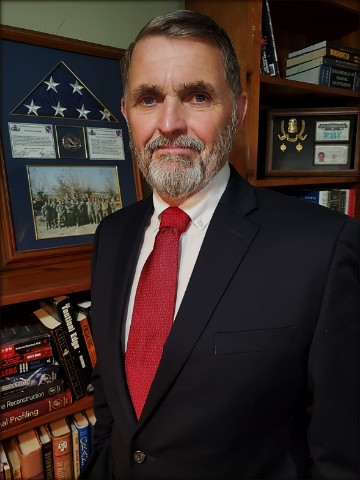 Consultant
Forty years of investigative casework, from patrolman in St. Louis County to the FBI in Chicago, and on to task forces in Afghanistan and Liberia. His work on the Idaho student murders is examined in Broken Plea, the New York Times bestseller by Christopher Whitcomb.
Full profileThe Hon. Richard A. Jones United States District Judge“Mr. Gilbertson’s qualifications demonstrate extensive experience in policing. His expansive work as a police officer in Georgia, with assignments as a SWAT team officer, juvenile court investigator, school resource officer, stakeout squad officer, senior patrolman, and patrolman; then a career as a tenured college professor and university lecturer teaching criminal justice courses to degree-seeking students at colleges and universities, and as a licensed private investigator conducting felony pretrial investigations for attorneys in Washington State in dozens of criminal cases, makes him unique in the field of police expert witnesses. The Court finds that, based on his experience, Mr. Gilbertson’s testimony can be expected to have a reliable basis in knowledge and experience of police practices.”
What this covers.
Within this engagement
- Agency policy and general-order analysis
- Written procedures measured against actual practice
- Generally accepted police practices and national standards
- Policy gaps, conflicts and outdated directives
- Training built on policy, and whether it was applied
- Supervisory enforcement of policy and procedure
The agency's policy manual and general orders, the training records built on them, body-worn video and reports of the incident, and any administrative review, compared directive by directive against generally accepted police practices and national standards on the totality of the circumstances.
Engagement terms and the published fee schedule: For Retaining Counsel →
Every kind of police claim carries a procedures question.
Whatever a police case is pleaded as, a question of police practices and procedures sits inside it, at the point where an officer's conduct meets what the agency directed. The directive at issue changes with the kind of claim.
In a use-of-force case, the question reaches past the force policy to the reporting directive: what the officer had to put in writing about the force, and how soon. The account the officer filed is tested against that directive and against use-of-force reporting standards. In an arrest case, it is the procedure the agency set for arrests made without a warrant, and what that procedure required of the arresting officer, on the street and on paper.
In a pursuit case, it is the vehicle pursuit directive or the agency's foot pursuit policy, and the conditions each set for starting a chase and ending one. In a claim about the investigation, it is the evidence and scene procedure: what had to be collected, logged and secured, and by whom. What the physical evidence itself shows is deferred to qualified experts in the relevant disciplines; whether the procedure was carried out is a practices question.
In a supervision claim that follows a use of force, it is the agency's directive on supervisor use-of-force reviews, read for the threshold at which a first-line supervisor had to respond and for when the written review was due. In each of these cases the first task of a police procedures expert witness is the same: to identify the directive that governed the conduct in question. In a sheriff's office the directives are typically the sheriff's general orders or policy manual, and how they are read against a deputy's conduct is set out under sheriff's office cases.
What counsel ask a police procedures expert witness.
The questions a procedures matter turns on can be put in plain terms: did the officer follow procedure, was there a procedure for this at all, should the officer have known it, and did anyone in the chain of command check. A police procedures expert witness answers each one by turning it into a question the record can settle.
The first becomes the comparison at a named step, made in the order the incident ran, as set out below. The second becomes a question about the manual, general order or bulletin in force that day, or about the absence of one. The third becomes a question for the training file and for the record of when the directive reached the officer. The fourth becomes a question about the review the directive required and the review that took place.
Two questions do not convert: whether an officer's account is true, which belongs to the trier of fact, and whether a departure caused the harm or makes anyone liable, which is for the court and the jury, argued by counsel. Legal conclusions remain counsel's, and the report does not answer either one.
One incident passes through several directives in turn.
An incident moves through a sequence of steps, and the analysis reads all of them, not only the moment the complaint is about. Each step answers to a directive of its own where the agency wrote one: the call and the response to it, the contact, any force, custody and transport, the reports written afterward, and the supervisory review that follows them. The report a police procedures expert witness writes keeps to that sequence, the order in which the incident ran rather than the order of chapters in the manual.
Nothing in the sequence replaces reading a police policy manual, which is how each directive is found and read once the agency produces it. What the sequence adds is the incident's own clock: which directive governed as the officers reached each step, and which duties an earlier step brought into play, such as the reporting and review a use of force can trigger.
Each step is then written up in one fixed form. It states the requirement, in the operative words of the directive, cited to the document produced. It states the conduct, from what the video, the dispatch entries and the written reports show at that step. It closes with the comparison, which either records a match or names the point where conduct and requirement part.
The fixed form is what makes the sequence usable. A step that matched its directive gets the same three entries as one that departed from it, and the form is identical in plaintiff and defense retentions. Each step is judged on what the officers knew when they reached it, not on how the incident ended, and compliance does not carry from one step to the next: force that met the force directive can still be followed by a report that fell short of the reporting directive.
Every step also answers to generally accepted police practices, and any departure is entered on the practices ledger. By itself it establishes neither a constitutional violation nor liability, and the report keeps the constitutional question on a separate ledger. Legal conclusions remain counsel's; the expert addresses police practices. The directive in force that day, and the officer's acknowledgment of it, are also topics of an officer's deposition, set out under deposing police officers.
How the procedure that governed a step is proven.
Before a step can be measured, the procedure that governed it has to be proven, and three sources answer different parts of that question. The directive shows what the agency required in writing, in the version in force that day. The training record shows what this officer was taught to do at that step, and when. The agency's practice shows how the same step was carried out and reviewed before this incident.
The training material does a second job when the words of a directive are in dispute. Where a directive leaves a term undefined, such as a requirement to act promptly or to notify a supervisor as soon as practicable, the lesson plans, scenario materials and training bulletins show how the agency itself taught officers to apply it. That reading rests on the agency's own records, made before the incident, rather than on the expert's preference or either side's.
Practice is proven the same way, from records made before the incident, such as earlier reports of the same step and what supervisors did with them. A claim that a step is done a certain way across a unit is tested against those records rather than accepted on testimony alone. Where the practice and the directive part, the report sets out both: the conduct measured against the directive that governed the step, and the practice recorded as a finding about the agency.
Where the written procedure ran out before the incident did.
The same sequence shows where the written procedure stopped. At some step the officers may have met a situation no directive addressed, or a directive may have covered the subject without reaching the circumstance in front of them.
That step keeps its place in the sequence and its form. In place of the requirement, the report records that no directive addressed it, and the conduct is measured against generally accepted police practices, with the source of that standard named for the step. The absence is itself a practices finding, and it concerns what the agency wrote rather than what the officer did.
Conduct that met accepted practice at an unwritten step is recorded as a match, as it would be at any step with a directive. Whether the agency's training or its practice filled the space the manual left is read across policy, practice and training rather than assumed from the silence.
The report stops at the practices finding and leaves its legal weight in any claim against the agency to counsel. The organizational analysis such a claim draws on belongs with failure to train and Monell.
What a supervisor's approval of a report does and does not record.
Paper that follows an incident ends in a supervisor's approval wherever the agency's directives require one: the arrest report, the search or inventory form, the pursuit report, the property and evidence entries. Each approval records a step of its own, the review the directives assigned to a supervisor, and it is read the way any other step is read.
The first question is what the signature stood for. A report-review directive may ask the reviewer to confirm that a report is complete and correctly filled in, or to judge whether the conduct it describes met the governing directive, or both. The review directive is read before anything is read into the signature, because an approval for completeness is not an approval of the conduct.
The second question is what the reviewer had at the moment of approval: the report alone, or the video and the dispatch record as well, and how long after the incident the approval came. Where the records system keeps them, earlier versions of the report and any request to correct it show what the reviewer asked to change before approving it.
An approval given under a directive that required a review of the conduct records that the agency's reviewer accepted that conduct at the time, and the report states it in those terms whichever side retained the analysis. What that acceptance means for any claim against the agency is counsel's question.
Related casework.
Case accounts as published by retaining counsel. No result is promised for any other matter.
Working references for this practice area.
Guides for retaining counsel, written from the same record this analysis reads.
“The judge mentioned the credibility of his report in hearings. Highly effective in securing a dismissal with prejudice for our client.”Dr. Stephen Pidgeon, Ph.D., Attorney at Law · Everett, WA
Before the record is sent.
When is a police procedures expert witness retained?
What does retention cost?
Does the analysis apply the agency's own policy or national standards?
What if two of the agency's directives conflict with each other?
What if the record does not show what happened at one step?
What if the officer followed a supervisor's order that departed from a written directive?
What if the supervisor who approved the report took part in the incident?
Send the policy and the record.
Attorney and law-firm inquiries only. Conflicts are checked before anything substantive, and you will hear about a conflict immediately.
Inquiry sent.
You will hear back directly. If the matter is urgent, call (239) 571-1840.
Conflicts are checked before any substantive discussion. Please do not send privileged material with a first inquiry; after retention the record is exchanged on physical media. Gregory consults for attorneys and their staff only, and does not provide legal advice or attorney referrals to individuals.