

Negligent Hiring &
Retention
Direct line: (239) 571-1840 · GregoryGilbertson@proton.me
Attorney and law-firm inquiries only
Some cases begin years before the incident, with personnel decisions made about an officer long before the conduct at issue. Hiring and retention analysis reads those decisions one at a time, each on the record the agency had when it was made.
Three experts. Over 110 years.
Professor Gregory Gilbertson (Ret.), FBI Special Agent Christopher Holland (Ret.), and Sheriff Robert Snaza consult with attorneys nationwide regarding police practices and procedures, use of force, false arrest, police misconduct, criminal, and self-defense casework.
 CEO & Owner
Thirty-eight years in four uniforms: street cop, soldier, professor, investigator. More than 220 matters in 42 states and D.C. since 2014.
Full biography Consultant
More than thirty-five years in public safety: Sheriff of Lewis County, Washington, since his election in 2015, and six years as a commissioner of the state board that sets peace-officer training standards.
Full profile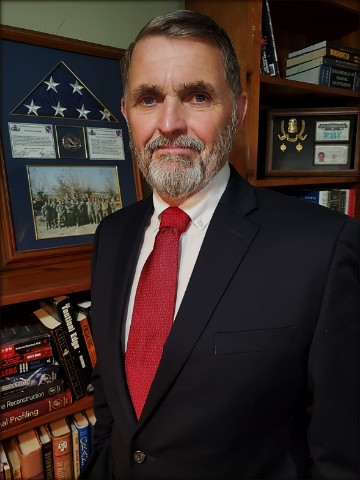 Consultant
Forty years of investigative casework, from patrolman in St. Louis County to the FBI in Chicago, and on to task forces in Afghanistan and Liberia. His work on the Idaho student murders is examined in Broken Plea, the New York Times bestseller by Christopher Whitcomb.
Full profileThe Hon. Richard A. Jones United States District Judge“Mr. Gilbertson’s qualifications demonstrate extensive experience in policing. His expansive work as a police officer in Georgia, with assignments as a SWAT team officer, juvenile court investigator, school resource officer, stakeout squad officer, senior patrolman, and patrolman; then a career as a tenured college professor and university lecturer teaching criminal justice courses to degree-seeking students at colleges and universities, and as a licensed private investigator conducting felony pretrial investigations for attorneys in Washington State in dozens of criminal cases, makes him unique in the field of police expert witnesses. The Court finds that, based on his experience, Mr. Gilbertson’s testimony can be expected to have a reliable basis in knowledge and experience of police practices.”
What this covers.
Within this engagement
- Officer hiring and background screening
- Negligent officer retention
- Prior complaints and disciplinary history
- Early-warning systems
- Command review and corrective action
Pre-employment and background records where produced, personnel and disciplinary files, early-warning data, and the agency's hiring and retention policies, against national personnel standards.
Engagement terms and the published fee schedule: For Retaining Counsel →
Each personnel decision has a date, a decision-maker and a file.
The agency approved the hire and confirmed the officer at the end of probation; at later points it kept the officer in place, returned the officer to duty or changed the assignment. Each of those decisions was made on a date, by a particular person, with a file in front of that person on that day.
For each decision, the analysis establishes what the file held on that date, what the agency's own written policy called for at that point, and what accepted personnel practice called for, then states where the decision and those standards agree and where they part. Counsel defending the agency receive the same reading from a police practices expert who is retained by both sides, and for them it documents each decision that tracked the written standard on the file then in hand.
Negligent hiring and retention claims, and organizational theories under Section 1983, are counsel's to plead and prove, and the vocabulary they use is collected in the supervision and Monell lexicon. Whether a departure at any decision point meets an element of any claim is outside the report, since legal conclusions remain counsel's and the expert addresses police practices. A missing background item or a required review the file does not show is recorded as a practices finding about that one decision. The line between such a finding and a constitutional violation, or liability, is drawn in the Library's guide to generally accepted police practices.
The reading runs without hindsight. The incident that brought the case is not in the file on the day of the hire, and the analysis does not carry it back into that day or into any decision made before it. Hiring standards and personnel policies can change over a career, so each decision is measured against the edition in force on its own date, not the edition current when the case was filed.
The hire, read from the background file as it stood that day.
Where the question is negligent hiring, the decision is read from the background investigation file: what the agency requested, what it received, and what the file shows it weighed before the hire was approved. The analysis reads that file for prior employment and each separation from it, and for records from prior law enforcement agencies where they could be obtained. The approval is then read for who gave it, on what date, and on what the file held when it was given.
The same file is read for certification history: the officer's status with the state commission, any action taken against the credential, and any query of the National Decertification Index. What each of those records is, and what it can show, is set out in the guide to POST certification; the hiring finding is limited to what the background file shows about them on the date of hire.
The yardstick is the agency's own hiring standard, in the edition in force on the date of hire, read with the accepted personnel practice of that time. Where the standard called for an item, the file is read for whether it was requested, whether it arrived and whether anything in the file addresses it, and each answer carries its own date.
Lateral hires add a record from the prior agency. The analysis reads what the hiring agency asked that agency for, when it asked, what came back and when, and whether the answer arrived before or after the hire was approved. A response dated after the approval is placed after that decision, not in the file the decision rested on.
The end of probation, and each later decision to keep the officer.
The end of probation is a decision to keep the officer, and the analysis reads it the way it reads the hire: who confirmed the officer, on what date, and which records the confirmation cites, each read as it stood on that date. The field training file behind that confirmation has its own guide, field training records, which covers remediation and the release to solo patrol.
Each later point at which the agency kept the officer is read the same way: after a sustained complaint, after discipline, after an early warning intervention, at a return to duty and at a reassignment. At each, the questions are who decided and on what file, and what the agency's policy required at that point, whether a review, a sign-off or nothing further.
A point can also pass with no decision at all. Where the agency's policy called for a review and the file shows none, the absence is itself recorded, with the date the policy applied and the provision that called for the review. The officer's continued service past that date is stated as what followed, not as a finding about the officer.
The records behind those points are the ground covered by internal affairs review, and how a flag is raised and answered is traced in the guide to early warning systems and supervision. When the question widens from this officer to whether the agency made the same kind of decision about other officers, it becomes a pattern question, and the analysis moves to Monell pattern and practice. Where the misconduct at issue was sexual, the hiring and retention decisions are one part of a wider record, taken up under sexual misconduct under color of authority.
Working references for this practice area.
Guides for retaining counsel, written from the same record this analysis reads.
Before the record is sent.
When does retention become the story?
What does retention cost?
What if the prior agency's records were never requested?
Does the analysis cover officers hired before current standards existed?
How does the report attribute a retention decision that nobody signed?
Send the hiring and retention file.
Attorney and law-firm inquiries only. Conflicts are checked before anything substantive, and you will hear about a conflict immediately.
Inquiry sent.
You will hear back directly. If the matter is urgent, call (239) 571-1840.
Conflicts are checked before any substantive discussion. Please do not send privileged material with a first inquiry; after retention the record is exchanged on physical media. Gregory consults for attorneys and their staff only, and does not provide legal advice or attorney referrals to individuals.