

The Monell Record,
Document by Document.
Direct line: (239) 571-1840 · GregoryGilbertson@proton.me
Attorney and law-firm inquiries only
Municipal liability is an organizational case, and organizations speak through documents. This checklist organizes the records that show policy, custom, training and notice, theory by theory, so the file gets built while discovery is still open rather than regretted after it closes.
Three experts. Over 110 years.
Professor Gregory Gilbertson (Ret.), FBI Special Agent Christopher Holland (Ret.), and Sheriff Robert Snaza consult with attorneys nationwide regarding police practices and procedures, use of force, false arrest, police misconduct, criminal, and self-defense casework.
 CEO & Owner
Thirty-eight years in four uniforms: street cop, soldier, professor, investigator. More than 220 matters in 42 states and D.C. since 2014, with testimony that has not been excluded at trial in any state or federal court.
Full biography Consultant
More than thirty-five years in public safety: twelve years and three terms as the elected Sheriff of Lewis County, Washington, and six years a commissioner of the state board that sets peace-officer training standards.
Full profile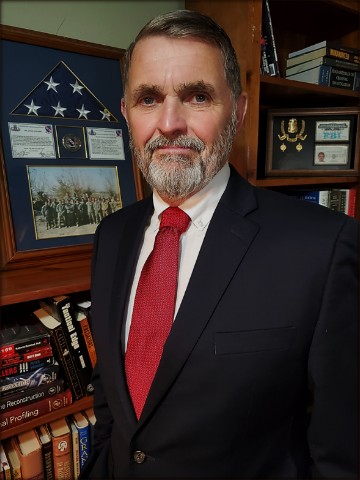 Consultant
Forty years of investigative casework, from patrolman in St. Louis County to the FBI in Chicago, and on to task forces in Afghanistan and Liberia. His work on the Idaho student murders is examined in Broken Plea, the New York Times bestseller by Christopher Whitcomb.
Full profileNever excluded. Professor Gilbertson’s testimony has not been excluded at trial in any state or federal court.
The Hon. Richard A. Jones United States District Judge“Mr. Gilbertson’s qualifications demonstrate extensive experience in policing. His expansive work as a police officer in Georgia, with assignments as a SWAT team officer, juvenile court investigator, school resource officer, stakeout squad officer, senior patrolman, and patrolman; then a career as a tenured college professor and university lecturer teaching criminal justice courses to degree-seeking students at colleges and universities, and as a licensed private investigator conducting felony pretrial investigations for attorneys in Washington State in dozens of criminal cases, makes him unique in the field of police expert witnesses. The Court finds that, based on his experience, Mr. Gilbertson’s testimony can be expected to have a reliable basis in knowledge and experience of police practices.”
The frame, then the file.
Monell v. Department of Social Services, 436 U.S. 658 (1978) makes municipal liability turn on the entity’s own policy, custom or deliberate indifference rather than on an officer’s conduct standing alone, and the failure-to-train branch of that liability is framed by City of Canton v. Harris, 489 U.S. 378 (1989). That is the law in one line, and it is the last legal statement on this page: the elements, and whether any record meets them, are counsel’s. Everything below is about the record.
The organizational case is a document case. No single record carries it; the showing is cumulative, assembled from categories that each exist somewhere in the agency’s files. In practice the problem is rarely that the documents never existed. It is that they were requested late, requested narrowly, or read in isolation from one another. The checklist exists to prevent all three. The doctrine itself, at practitioner level, is covered in what is a Monell claim; this page is the working list for the record behind it.
The practical teaching is narrower than the doctrine: organizational claims are records claims. What was taught, to whom, and when; what the agency knew about the need and when it knew it; what practice actually looked like on the street as opposed to in the manual. All of it lives in documents the agency already holds, which means the case is won or lost partly at the request-drafting stage.
The records, organized by theory.
Most municipal cases draw on several theories at once, and the categories below overlap by design: the same complaint history that shows custom under one theory shows notice under another. Request them together, read them together, and set the date ranges deliberately: a window reaching back years before the incident is what lets repetition and notice emerge, and revision histories only make sense whole.
Policy and custom
This group establishes what the organization’s stated rule was, and for how long. The revision history matters because the policy in force on the incident date is only part of the story: what the agency changed, when, and in response to what is often the sharpest notice evidence in the file.
- Written policies in force on the incident date, plus every prior revision with its dates
- General orders, directives and memoranda that modify or interpret the governing policy
- Accreditation files and self-assessments where the agency participates in CALEA
- Audits, consultant reviews and outside assessments touching the practice at issue
- Forms and templates the agency uses for the task, which often encode the real procedure
Training
Curricula show what the agency intended to teach; the officer files show what was actually delivered, to whom, and when. The gap between those two is where failure-to-train analysis lives, which is why both halves are requested rather than the curriculum alone.
- Academy curricula and lesson plans for the tasks the incident involved
- The involved officers’ complete training files, with courses, dates and hours
- In-service calendars showing what the agency taught after each policy revision
- Qualification and refresher records for the specific skills at issue
- Field training program materials and the involved officers’ field training evaluations
Complaints, force reports and discipline
This group is the practice layer: what line conduct looked like over time and what the organization did about it. The supervisor review sections matter as much as the underlying reports, because they show whether review was substance or signature.
- Complaint histories for the involved officers, their unit and, where obtainable, the agency
- Use-of-force reports across time, including the supervisor review sections
- Internal affairs files and their dispositions across the relevant period
- Disciplinary records, and the framework the agency says governs discipline
- Early warning system thresholds, flag histories and documented responses
Notice and response
This group dates the organization’s knowledge. Distribution lists and routing records answer who saw a document and when, which is why they are requested with the documents themselves rather than left behind as administrative clutter.
- Prior similar incidents, and the documents showing what changed after each
- Claims and litigation history involving the same practice
- Command-level correspondence and meeting records addressing the practice, where discovery reaches them
- Post-incident reviews and after-action documents, with their distribution lists
What a pattern looks like on paper.
An isolated incident reads one way in documents: a single event, no relevant prior history, an agency response after the fact. A pattern reads differently, and it reads that way across categories at once. Repetition: the same practice recurring across different officers, shifts and years, which is what distinguishes an organizational practice from an individual failure. Notice: paper showing the organization knew, in complaints, flags, prior suits, audit findings or its own internal reviews. Non-response: nothing changed, or the change appeared on paper and stopped there.
Repetition, notice and non-response are the load-bearing elements, and dates matter more than volume. Documents that predate the incident are what separate an organization that knew from one that learned. A thick remedial file assembled after the event shows a response; a thin memorandum dated years earlier shows notice. The checklist is built to surface both, which is why revision histories and distribution lists appear alongside the documents themselves.
The converse is read with the same discipline. An agency whose records show policy revised after each prior event, training delivered on the revision, discipline tracking findings, and trends monitored afterward reads as a functioning organization, and when the record shows that, the analysis says that. The checklist is side-neutral; the documents decide what it yields.
Volume alone is not a pattern. A larger agency generates more of everything, so the reading always asks what the numbers were relative to, what the agency’s own review made of them, and what happened next.
From boxes of records to a measured comparison.
Collection is half the work; the reading method is the other half. Each category is measured against national standards, with IACP model policies, PERF guidance, CALEA accreditation standards and state POST requirements as the reference points for generally accepted practices. Then the layers are read against each other, because the organizational story usually lives in the gaps between what the agency wrote, what it taught and what it tolerated. That three-layer method is covered in policy, practice and training.
Supervision records get their own pass: whether an early warning system existed, whether it fired on the involved officers, and what supervision did next, read the way early warning systems and supervision describes. Internal affairs files are read for whether findings track the evidence gathered, and disposition patterns across years are treated as a record of practice in their own right, not just a stack of closed cases.
The output is a measured comparison stated at practices level: what the record shows the organization knew, when it knew it, what it did, and how that conduct compares to national standards and to the agency’s own written commitments. Where the record is incomplete, the report says what is missing and what would resolve it, which itself tells counsel where the next discovery request goes.
The expert’s lane, and counsel’s.
The division of labor is clean. The expert documents and measures the organizational record against national standards and the agency’s own policy, and states where practice diverged from both. Counsel owns the legal architecture: which theory the record supports, how the elements are framed, and what any of it establishes. Legal conclusions remain counsel’s throughout; the opinions address police practices, and the report says so on the record.
Sequencing favors the early start. Expert reports require sixty days of advance notice, and organizational records take longer to obtain than incident records: revision histories, disposition runs and system data arrive slowly and are worth pursuing while discovery is open. The checklist is built to be handed to the team drafting requests, then read as one record when the production arrives.
When it does arrive, indexing discipline matters more than reading order: every document gets a date, a source and a category. Notice questions are sequence questions, so the organizational record gets the same dated, attributed timeline treatment described in building the record chronology: what the agency knew, tied to when the record shows it knew it.
Discovery scope is a legal question, and no checklist substitutes for counsel’s judgment in a particular jurisdiction. This list states what a police practices analysis can use, not what any court will order produced.
When the question becomes a retention.
This page is reference. When a live matter needs the analysis, these are the doors.
Asked alongside this one.
What records support a Monell pattern and practice case?
How does a pattern differ from an isolated incident in agency records?
Does the expert opine on Monell liability itself?
Bring the matter behind the question.
Attorney inquiries are answered directly. If a case presents a conflict, you will hear it immediately.
Inquiry sent.
You will hear back directly. If the matter is urgent, call (239) 571-1840.
Conflicts are checked before any substantive discussion. Please do not send privileged material with a first inquiry; after retention the record is exchanged on physical media. Gregory consults for attorneys and their staff only, and does not provide legal advice or attorney referrals to individuals.