

What a high-risk warrant
service plan has to show.
Direct line: (239) 571-1840 · GregoryGilbertson@proton.me
Attorney and law-firm inquiries only
Before a tactical team approaches a door, two documents should already exist: a written risk assessment that justifies the method of service, and an operations plan built from it. This page states what each one contains, what the record holds afterward, and how both are read in litigation.
Three experts. Over 110 years.
Professor Gregory Gilbertson (Ret.), FBI Special Agent Christopher Holland (Ret.), and Sheriff Robert Snaza consult with attorneys nationwide regarding police practices and procedures, use of force, false arrest, police misconduct, criminal, and self-defense casework.
 CEO & Owner
Thirty-eight years in four uniforms: street cop, soldier, professor, investigator. More than 220 matters in 42 states and D.C. since 2014.
Full biography Consultant
More than thirty-five years in public safety: Sheriff of Lewis County, Washington, since his election in 2015, and six years as a commissioner of the state board that sets peace-officer training standards.
Full profile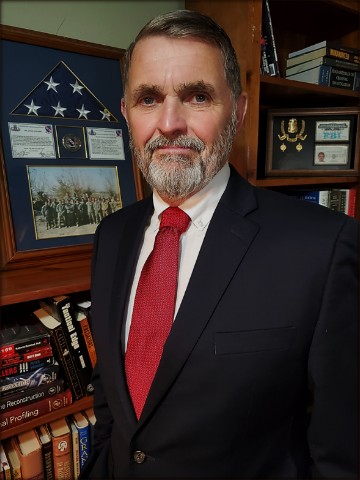 Consultant
Forty years of investigative casework, from patrolman in St. Louis County to the FBI in Chicago, and on to task forces in Afghanistan and Liberia. His work on the Idaho student murders is examined in Broken Plea, the New York Times bestseller by Christopher Whitcomb.
Full profileThe Hon. Richard A. Jones United States District Judge“Mr. Gilbertson’s qualifications demonstrate extensive experience in policing. His expansive work as a police officer in Georgia, with assignments as a SWAT team officer, juvenile court investigator, school resource officer, stakeout squad officer, senior patrolman, and patrolman; then a career as a tenured college professor and university lecturer teaching criminal justice courses to degree-seeking students at colleges and universities, and as a licensed private investigator conducting felony pretrial investigations for attorneys in Washington State in dozens of criminal cases, makes him unique in the field of police expert witnesses. The Court finds that, based on his experience, Mr. Gilbertson’s testimony can be expected to have a reliable basis in knowledge and experience of police practices.”
The risk assessment comes first.
A high-risk warrant service plan is the written product that decides how a warrant will be served and by whom. It begins with a risk assessment, often scored on a threat matrix the agency has adopted, which converts what is known about the address, the occupants and the offense into a recommendation about the method of service. The matrix is not a formality. It is the document that has to justify sending a special weapons and tactics (SWAT) team rather than having patrol officers knock at the door.
What a practices review reads in the matrix is not the score. It is the inputs: whether the factors scored were supported by current information, where each factor came from, and whether anything was scored on assumption. A matrix populated from an informant’s description that was never corroborated produces a number that looks objective and rests on nothing.
- The information base: what surveillance, records and corroboration actually established
- Address verification: how the target location was confirmed, by whom, and how recently
- Occupant identification: who was believed inside, including children and uninvolved residents
- Weapons and history: what was known, from what source, and how current that source was
- The scored factors, the method they recommended, and the supervisor who approved it
The operations plan, and the record it leaves.
The operations plan is built from the assessment, and it is meant to be specific enough that a person who was not at the briefing can read it and know what was supposed to happen. It names the team and the assignments, the time of service and why that time was chosen, the entry method, the announcement decision, the containment of the perimeter, and the medical support standing by. It also states contingencies, because a plan that anticipates nothing going differently is not a plan.
- Assignments: entry team, perimeter, arrest team, supervision and the commander on scene
- Timing: the hour chosen for service, and what supported choosing it
- Method: the approach, the announcement decision, and the breach plan if one was needed
- Occupant handling: children, uninvolved residents and any known medical needs on site
- Support: medical resources staged, the communications plan, and written contingencies
- Approval: the signature on the plan, its date, and whether the approver saw the matrix or only the summary
After the service the paper continues. The briefing roster shows who was present and what they were told, which matters when officers later describe different understandings of the same plan. The after-action report states what happened against what was planned, and an agency that writes candid after-action reports produces a better record for itself than one that writes summaries.
A plan can be sound and the service still go wrong, and a plan can be thin and the service go fine. These documents are read for what they show about the decisions that were made in advance, not backward from the outcome at the door.
How the documents are used, and where the line sits.
In wrong-address cases the assessment and the plan usually settle the practices question, because address verification is a planning step that leaves a documentary trace with a date on it. The review asks which factor on the matrix recorded the location, what source supplied it, and when it was last checked against anything current. It then asks whether the briefing repeated an address nobody had verified since the file was opened, and whether the after-action report took up the discrepancy or passed over it.
In entry and force cases the plan sets the baseline the conduct is measured against. What the team was briefed to do, what it actually did, and what the video shows in sequence produce a three-way comparison, and departures from the plan are findings whether or not they turn out to matter. Force applied once inside is analyzed on its own terms, against agency policy and the decision models officers are trained on, described in force options and decision models.
The service method and the legal authority behind it are two questions, and only one of them belongs to the expert. What authorization to enter without knocking and announcing actually is, and what the application had to show, is the subject of what a no-knock warrant is. The force vocabulary that applies once the team is inside is defined in the lexicon of use of force terms. What the plan and the matrix show is a practices finding. What the entry means for suppression or liability is a legal conclusion that belongs to counsel, and the report keeps the two apart on its face.
When the question becomes a retention.
This page is reference. When a live matter needs the analysis, these are the doors.
Adjacent reading.
Asked alongside this one.
What is the difference between a risk assessment and an operations plan?
Which documents show whether a warrant was served at the right address?
What does the after-action report add to a warrant file?
Bring the matter behind the question.
Attorney inquiries are answered directly. If a case presents a conflict, you will hear it immediately.
Inquiry sent.
You will hear back directly. If the matter is urgent, call (239) 571-1840.
Conflicts are checked before any substantive discussion. Please do not send privileged material with a first inquiry; after retention the record is exchanged on physical media. Gregory consults for attorneys and their staff only, and does not provide legal advice or attorney referrals to individuals.