

What a no-knock warrant is,
and how the entry is examined.
Direct line: (239) 571-1840 · GregoryGilbertson@proton.me
Attorney and law-firm inquiries only
A no-knock warrant authorizes officers to enter a residence without first knocking, announcing identity and purpose, and waiting. This page states what that authorization is, how it differs from an entry decided at the door, and what the record has to show about how it was obtained and executed.
Three experts. Over 110 years.
Professor Gregory Gilbertson (Ret.), FBI Special Agent Christopher Holland (Ret.), and Sheriff Robert Snaza consult with attorneys nationwide regarding police practices and procedures, use of force, false arrest, police misconduct, criminal, and self-defense casework.
 CEO & Owner
Thirty-eight years in four uniforms: street cop, soldier, professor, investigator. More than 220 matters in 42 states and D.C. since 2014, with testimony that has not been excluded at trial in any state or federal court.
Full biography Consultant
More than thirty-five years in public safety: twelve years and three terms as the elected Sheriff of Lewis County, Washington, and six years a commissioner of the state board that sets peace-officer training standards.
Full profile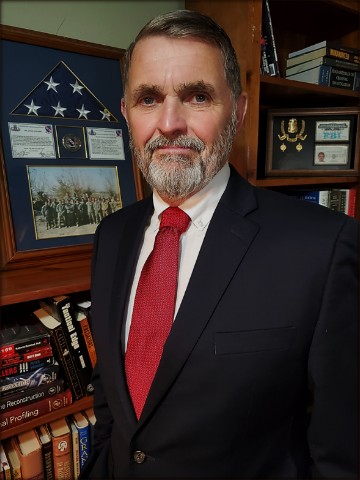 Consultant
Forty years of investigative casework, from patrolman in St. Louis County to the FBI in Chicago, and on to task forces in Afghanistan and Liberia. His work on the Idaho student murders is examined in Broken Plea, the New York Times bestseller by Christopher Whitcomb.
Full profileNever excluded. Professor Gilbertson’s testimony has not been excluded at trial in any state or federal court.
The Hon. Richard A. Jones United States District Judge“Mr. Gilbertson’s qualifications demonstrate extensive experience in policing. His expansive work as a police officer in Georgia, with assignments as a SWAT team officer, juvenile court investigator, school resource officer, stakeout squad officer, senior patrolman, and patrolman; then a career as a tenured college professor and university lecturer teaching criminal justice courses to degree-seeking students at colleges and universities, and as a licensed private investigator conducting felony pretrial investigations for attorneys in Washington State in dozens of criminal cases, makes him unique in the field of police expert witnesses. The Court finds that, based on his experience, Mr. Gilbertson’s testimony can be expected to have a reliable basis in knowledge and experience of police practices.”
A no-knock warrant, stated plainly.
Standard practice for serving a warrant at a residence is knock-and-announce: officers knock, identify themselves as police, state their purpose, and wait a reasonable time for the occupants to respond before forcing entry. A no-knock warrant is a warrant on which the issuing judge has authorized officers to skip that sequence, based on a particularized showing in the application about this address, these occupants and this investigation.
Particularized is the operative word in the practices review. A showing that recites the general dangers of a category of offense is not the same as a showing that identifies specific facts about the target location: who is known to be inside, what is known about weapons there, what surveillance established, and what supports the belief that announcing would defeat the purpose of the warrant or endanger the officers serving it.
Three entries that get confused with each other.
- Knock-and-announce service, the default sequence for warrant execution at a residence
- No-knock authority granted in advance on the face of the warrant, on a showing made to the judge
- An unannounced or shortened entry decided at the door on exigent circumstances the officers encounter
- Dynamic entry as a tactical method, which is a planning choice separate from the announcement question
The tactical method and the announcement authority are distinct questions. A warrant can authorize no-knock entry and still be served slowly and deliberately, and a knock-and-announce warrant can be executed with a forced entry moments after the announcement. The record has to be read for both.
What the analysis examines, from application to entry.
The questions a police practices analysis puts to a no-knock entry follow the operation in order, and each one is answered from documents rather than from recollection. The comparison is against the agency’s own policy, the officers’ training, and national standards, model policies and training curricula on high-risk warrant service, on the totality of the facts and circumstances known at the time.
The four stages, and the records behind them.
- The application: what the affidavit actually showed about this location, how current the information was, and whether the source was corroborated independently
- The planning: the written operational plan, the risk assessment, target and occupant identification, the time of service chosen, and whether children or uninvolved occupants were accounted for
- The briefing: what the entry team was told, who approved the operation and at what rank, and whether the approving supervisor reviewed the plan or signed it
- The alternatives: whether surveillance, service away from the residence, or a surround-and-callout approach was considered and documented before a no-knock entry was chosen
- The execution: announcement or its absence, the delay before breach, the breach method, control of the scene once inside, and force used on occupants
- The accounting: body-worn camera activation, dispatch and radio timelines, entry logs, and the after-action review the agency conducted
Address verification deserves its own line. A wrong-address entry is a planning and verification failure that the record either explains or does not, and the documents that answer it are the surveillance notes, the target packet and the briefing materials rather than the warrant itself. The tactical side of the same operation is treated on the SWAT and high-risk operations page, and the force used after entry is analyzed under Graham v. Connor, 490 U.S. 386 (1989), on what the officers knew at that moment, without hindsight.
Measured against the policy in force at the time.
Many agencies have tightened their own policies on no-knock entries in recent practice, and some jurisdictions have restricted or barred them outright. That movement matters to the analysis in one specific way: conduct is measured against the policy and the standards in force when the warrant was served, not against a policy adopted afterward. Where an agency has since changed its rule, the change is a fact about the agency, not a standard applied backward to the officers.
The threshold showings that support a warrant application are the subject of reasonable suspicion and probable cause, and the entry itself sits inside the broader search and seizure practice area covering warrants and no-knock entries. Whether a particular entry was lawful, and whether suppression or liability follows, are legal conclusions that remain counsel’s. The expert addresses police practices: what the application showed, how the operation was planned, approved and briefed, and how the entry was actually carried out.
When the question becomes a retention.
This page is reference. When a live matter needs the analysis, these are the doors.
Asked alongside this one.
What is the difference between a no-knock warrant and an exigent entry?
Which documents matter most in reviewing a no-knock entry?
Does the analysis say whether a no-knock entry was constitutional?
Bring the matter behind the question.
Attorney inquiries are answered directly. If a case presents a conflict, you will hear it immediately.
Inquiry sent.
You will hear back directly. If the matter is urgent, call (239) 571-1840.
Conflicts are checked before any substantive discussion. Please do not send privileged material with a first inquiry; after retention the record is exchanged on physical media. Gregory consults for attorneys and their staff only, and does not provide legal advice or attorney referrals to individuals.