

Body-Worn Camera Policy,
Read Against the Record
Direct line: (239) 571-1840 · GregoryGilbertson@proton.me
Attorney and law-firm inquiries only
A body-worn camera (BWC) program is a set of written rules about when a camera runs, who may watch what it recorded, and how long the file is kept. This guide sets out the four questions every program answers, and how compliance with them is read on the record.
Three experts. Over 110 years.
Professor Gregory Gilbertson (Ret.), FBI Special Agent Christopher Holland (Ret.), and Sheriff Robert Snaza consult with attorneys nationwide regarding police practices and procedures, use of force, false arrest, police misconduct, criminal, and self-defense casework.
 CEO & Owner
Thirty-eight years in four uniforms: street cop, soldier, professor, investigator. More than 220 matters in 42 states and D.C. since 2014.
Full biography Consultant
More than thirty-five years in public safety: Sheriff of Lewis County, Washington, since his election in 2015, and six years as a commissioner of the state board that sets peace-officer training standards.
Full profile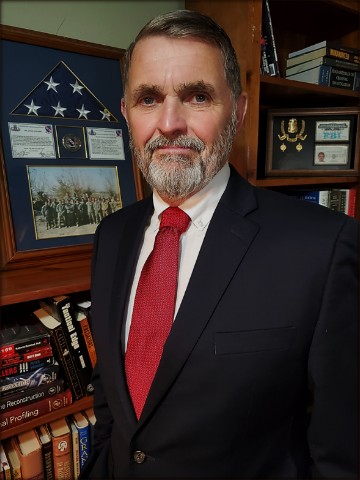 Consultant
Forty years of investigative casework, from patrolman in St. Louis County to the FBI in Chicago, and on to task forces in Afghanistan and Liberia. His work on the Idaho student murders is examined in Broken Plea, the New York Times bestseller by Christopher Whitcomb.
Full profileThe Hon. Richard A. Jones United States District Judge“Mr. Gilbertson’s qualifications demonstrate extensive experience in policing. His expansive work as a police officer in Georgia, with assignments as a SWAT team officer, juvenile court investigator, school resource officer, stakeout squad officer, senior patrolman, and patrolman; then a career as a tenured college professor and university lecturer teaching criminal justice courses to degree-seeking students at colleges and universities, and as a licensed private investigator conducting felony pretrial investigations for attorneys in Washington State in dozens of criminal cases, makes him unique in the field of police expert witnesses. The Court finds that, based on his experience, Mr. Gilbertson’s testimony can be expected to have a reliable basis in knowledge and experience of police practices.”
The four questions every camera policy answers.
A camera program is only as clear as the written policy behind it. What varies between agencies is not which of these a policy addresses but what it says about each.
- Activation: which events require the camera to be recording, and at what point in the encounter the duty attaches
- Deactivation: when recording may stop, and what the officer must state or document before stopping it
- Review: who may watch the footage and when, including whether an involved officer may watch before writing
- Categorization and retention: how a recording is classified, how long each class is kept, and who may place a hold
Activation rules are usually written around call types and officer actions rather than around outcomes: a dispatched call, an enforcement contact, a search, a pursuit, any use of force. The practical consequence is that the duty to record attaches early, before anyone knows the encounter will matter, which is why the activation point is so often contested afterward.
Deactivation and review are where policies diverge most. Some agencies require a recorded statement of the reason before a camera is switched off. Some require the report to be written before any viewing, others permit review first. National model policies and the guidance of bodies such as the International Association of Chiefs of Police (IACP) and the Police Executive Research Forum (PERF) describe what a sound program generally looks like, but the governing document in any case is the agency’s own policy as it read on the date of the incident. What the report itself has to contain is set out in use-of-force reporting standards.
Retention rules decide what still exists. A recording classified as non-evidentiary can age off on a short schedule, so a classification decision made in the first days often determines what counsel can obtain later.
Written policy against actual practice.
A policy is a claim about how an agency operates. The analysis treats it as a claim and then checks it. The first step is obtaining the version in force on the incident date, including any general order or training bulletin that modified it, and not the manual as it stands at production.
The second step is compliance on this incident: whether the involved officers activated when the policy required, deactivated only when it permitted, and documented what it required them to document. The third step is the pattern. Where the same officers, or the same shift, routinely departed from the rule and no supervisor addressed it, the question stops being about one recording and becomes a supervision question about the agency.
Compliance also depends on whether the rule was ever delivered. Whether the rule was ever delivered is a training-file question, and the acknowledgment record proves distribution and nothing more.
That distinction matters in both directions. An isolated failure by an officer who otherwise complied is a different fact from a unit in which nobody activated and every supervisor approved the paperwork anyway. Where the record shows a program that was written, trained, audited and enforced, the analysis states that with the same plainness it uses for the opposite finding.
What activation data and access records show.
Camera systems keep records of their own, and those records carry times no narrative can supply. Depending on the platform, and without any claim about what is inside a file, those records report when a recording started and stopped, which device and assigned user produced it, whether a buffered segment preceded the event, how the recording was categorized, and who later viewed, downloaded or reclassified it. What a given system actually logged, and how long it kept the log, is itself a request item.
- Activation and deactivation times for every device present on the call
- The presence or absence of a pre-event buffer segment, and its length as the system reports it
- Category assignment, and any later change to it, with the user who made the change
- Access history: who viewed or downloaded a recording, and when, relative to the reports and interviews
- Retention holds placed, or not placed, once the incident became a claim
Access history is often the item left out of a first production. A viewing that occurred before a report was written, or before an interview was given, is a dated fact bearing directly on the sequence in which an account was formed, and it comes from the system rather than from anyone’s memory.
The boundary here is firm. Reading the times, users and categories a system reports is practices work. Questions about file integrity, metadata authenticity or the enhancement of an image are not: those questions are deferred to qualified digital forensics and forensic video experts, on the record, and the practices opinion states the deferral rather than reaching past it.
Absent, late and interrupted recording.
The recording that does not exist is a routine problem, and it is analyzed as a policy and practice question rather than as a stand-in for the footage. There are ordinary explanations and there are others, and the surrounding record usually distinguishes them.
- No activation at all, where policy required recording for that category of event
- Late activation, leaving the approach and the first contact unrecorded
- Early deactivation, ending the recording before the aid, the search or the transport
- A recording made and then categorized so that it aged off the retention schedule
- Equipment problems, where assignment and maintenance records either corroborate the account or do not
The analysis will not say what the missing footage would have shown. Absence proves absence. It is measured against the requirement in place, against what the officer said about it, and against how the agency responded once it learned the recording was missing, including whether anyone reviewed or documented the failure at all.
The agency’s response is frequently the more probative fact. A missing recording that produced a supervisory inquiry, a documented explanation and a correction shows a program handling a lapse. The same lapse repeated across a unit, unremarked in any supervisory record, is evidence about the organization rather than about one officer.
How footage is read against the rest of the record.
A recording shows what one camera captured from where it was worn, beginning at the moment it activated. Placing it beside the other clocks in the file is the work of building the record chronology, and that work comes before any written account is measured against the footage. Once the sequence is settled, the recordings are read against the reports, the computer-aided dispatch (CAD) entries and the statements, one asserted fact at a time.
Three comparisons recur. The activation point on the camera’s own clock is set against the report’s account of arrival. A command the report says was given is checked against what the microphone carried at the stated time, or did not. The deactivation is set against the aid, the transport and the handoff the report describes. Each is entered as a dated comparison, and nothing further is inferred from any of them.
Where the footage and a written account diverge, the divergence is entered against both sources and left standing. The recurring shapes those divergences take are treated in the brief on how police reports fail, and the vocabulary for each record is collected in the records and reports lexicon. What a divergence means is for counsel to argue: the expert addresses police practices, and legal conclusions remain counsel’s.
Requesting the camera record.
A camera question is worked from the policy, the recordings and the system’s own logs. The logs are the family most often left out of a first production, and the compliance audits are the item counsel most often does not know to ask for.
- The camera policy in force on the incident date, with any general order, bulletin or training material that changed it
- Every recording from every device present, produced as kept rather than as clipped excerpts
- Activation and access logs for those devices and those recordings, covering the days after the incident as well as the day of it
- The categorization and retention schedule, and the record of any hold placed once the incident became a claim
- Any audit the agency ran on activation compliance, for the involved officers and for the unit
- The training the involved officers received on the camera policy, and their acknowledgment of it
The audits are worth pressing for. Many programs check compliance on some cycle, and an audit is the agency’s own measurement of the distance between its written policy and its actual practice, taken before this incident and without reference to it, which is the closest thing to a neutral measurement the file will contain.
When the question becomes a retention.
This page is reference. When a live matter needs the analysis, these are the doors.
Adjacent reading.
Asked alongside this one.
When does a body-worn camera policy require activation?
Who may review body-worn camera footage, and when?
What does missing body camera footage establish?
Bring the matter behind the question.
Attorney inquiries are answered directly. If a case presents a conflict, you will hear it immediately.
Inquiry sent.
You will hear back directly. If the matter is urgent, call (239) 571-1840.
Conflicts are checked before any substantive discussion. Please do not send privileged material with a first inquiry; after retention the record is exchanged on physical media. Gregory consults for attorneys and their staff only, and does not provide legal advice or attorney referrals to individuals.