

The Use-of-Force Report,
and What It Must Contain
Direct line: (239) 571-1840 · GregoryGilbertson@proton.me
Attorney and law-firm inquiries only
A use-of-force report is the account an agency requires from the officer who used force, written on the agency’s own form. This guide sets out what generally accepted practice requires that document to contain, how it differs from the incident report and from later supplements, and how the analysis reads what is present and what is absent.
Three experts. Over 110 years.
Professor Gregory Gilbertson (Ret.), FBI Special Agent Christopher Holland (Ret.), and Sheriff Robert Snaza consult with attorneys nationwide regarding police practices and procedures, use of force, false arrest, police misconduct, criminal, and self-defense casework.
 CEO & Owner
Thirty-eight years in four uniforms: street cop, soldier, professor, investigator. More than 220 matters in 42 states and D.C. since 2014.
Full biography Consultant
More than thirty-five years in public safety: Sheriff of Lewis County, Washington, since his election in 2015, and six years as a commissioner of the state board that sets peace-officer training standards.
Full profile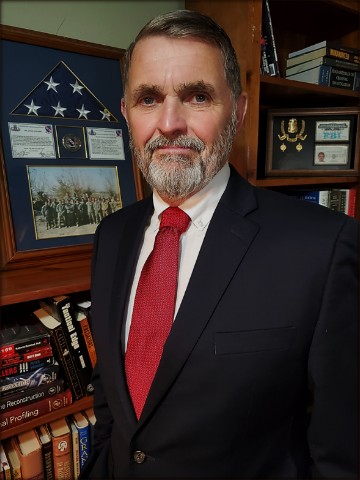 Consultant
Forty years of investigative casework, from patrolman in St. Louis County to the FBI in Chicago, and on to task forces in Afghanistan and Liberia. His work on the Idaho student murders is examined in Broken Plea, the New York Times bestseller by Christopher Whitcomb.
Full profileThe Hon. Richard A. Jones United States District Judge“Mr. Gilbertson’s qualifications demonstrate extensive experience in policing. His expansive work as a police officer in Georgia, with assignments as a SWAT team officer, juvenile court investigator, school resource officer, stakeout squad officer, senior patrolman, and patrolman; then a career as a tenured college professor and university lecturer teaching criminal justice courses to degree-seeking students at colleges and universities, and as a licensed private investigator conducting felony pretrial investigations for attorneys in Washington State in dozens of criminal cases, makes him unique in the field of police expert witnesses. The Court finds that, based on his experience, Mr. Gilbertson’s testimony can be expected to have a reliable basis in knowledge and experience of police practices.”
What a use-of-force report is for.
Inside an agency, a use-of-force report is not a litigation document. It is the record the organization keeps of force its own officers applied, created for internal purposes long before anyone files a claim. That origin is what gives the document weight later: it was written to satisfy the agency, on the agency’s own form, under the agency’s own rule.
Four institutional jobs depend on it. A supervisor reviews the force against policy and either signs off or does not. The agency counts and classifies force so that command can see what officers are actually doing over time. Training staff learn which tactics are being used and which are failing in the field. And an internal affairs (IA) inquiry, if one opens, starts with the paper the incident already generated.
Because those jobs are internal, the requirements are not exotic. National model policies and training curricula, including the work of the International Association of Chiefs of Police (IACP) and the Police Executive Research Forum (PERF), describe the same recognizable expectation: an officer who uses force writes down what happened, in that officer’s own words, promptly, in enough detail for a supervisor who was not there to evaluate it. That expectation is the baseline a report is measured against.
The first question in a case is never what a national model policy says. It is what this agency’s own use-of-force reporting policy required on the date of the incident, and whether the agency followed it.
What a complete report documents.
A complete use-of-force report answers a supervisor’s questions without a follow-up conversation. Generally accepted practice, as reflected in national model policies and in agency reporting rules, treats the following as the working content of that document.
One threshold question comes before the content. Agencies generally define in writing which force has to be reported at all, and where that line sits, or whether one was ever written, decides whether a document exists to be read. Counsel meeting a file with no force report should establish the agency’s own reporting threshold before treating the absence as anything else.
Before the force was used.
- What the officer knew on arrival: the dispatched call, the information broadcast, and what was observed on approach
- The subject’s actions as they presented, including the resistance or the threat the officer perceived
- Warnings and commands given, the opportunity to comply, and any reason a warning was not feasible
- Alternatives attempted or considered before the option used, where policy and training placed them on the table
The force, and everything after it.
- The specific force used, by which officer, how many times, and applied to what
- Injuries observed on any person present, and the aid requested or rendered, with times
- Witnesses identified by name and contact information, civilian and officer alike
- Evidence secured, photographed or booked, including the scene itself and any weapon
- The supervisor notified, when the notification was made, and what the supervisor did on scene
- Times throughout: the call, the arrival, the force, the aid, the notification and the writing
Two of those requirements do most of the work in litigation. The first is attribution: force is documented officer by officer rather than as a squad, so a narrative reporting that officers deployed force without saying which officer did what has already fallen short of the standard. The second is enumeration: each separate application is reported with the reason for it at the point it occurred, so an account that compresses several applications into one clause cannot be tested against the footage.
Nothing on either list calls for a legal judgment. Every item is an observable fact the writing officer had access to, which is exactly why the elements can be checked against the rest of the record item by item, years later, by someone who was not there.
The incident report, the force form and the supplement.
Counsel receiving a production often finds overlapping documents and no map. The incident or arrest report narrates the call: who, what, where, the offense and the disposition. It exists whether or not force was used, and it is frequently written by an officer other than the one who used force.
The use-of-force report is the separate accounting of the force itself, and in most agencies it lives on a dedicated form or in a records module with required fields: the option used, the subject’s actions, injuries, aid, and supervisory notification. The form matters analytically, because a field the agency chose to require and then left blank is a documented omission rather than an editorial choice about a narrative.
An officer’s supplement is filed later, by its own author and with its own time stamp, and the analysis reads it next to the original without folding the two together. Counsel should also note that the same word names an entirely different document in litigation, the testifying expert’s own updated disclosure, which is covered in the brief on what a supplemental report is.
Ask for the force form, the narrative and every supplement as separate items. A request for the report can come back as the narrative alone, with no force form attached to it.
Whether the officer reviewed footage before writing.
Whether an involved officer may watch body-worn camera footage before writing is a policy choice, and agencies land in different places on it. The rule itself, and the access records that show whether a viewing occurred, are treated in body-worn camera policy and footage review. What belongs on the reporting side is narrower, and it begins with no assumption about which rule this agency chose: what the document itself has to disclose about its own making.
Where the agency’s policy requires a report written after a viewing to disclose it, the report is read for that disclosure. Where the agency required an account from memory first, an addendum written after review is a separate document with its own time, and the analysis reads the report for that disclosure and the file for the paperwork that matches it. Where the report is silent and nothing else in the file marks a viewing, the silence is documented against whatever the agency required its officers to record.
The reverse is equally a finding. Where policy permitted review and the report acknowledges it plainly, an account that tracks the footage is what the agency asked for, and the analysis says so in those terms. The sequence, in either direction, establishes when an account was formed. It does not establish intent.
How gaps and inconsistencies are read.
A missing element is a question, not a conclusion. The analysis sets each requirement beside the rest of the record and asks what the other sources say about it: the video, the computer-aided dispatch (CAD) entries, the radio traffic, the booking and medical paperwork, and the statements taken afterward. On the force paperwork itself the checks are narrower, because the form the agency designed can fail in ways a narrative cannot.
- A required field on the force form left blank, measured against the policy that made it required
- A force option recorded on the form that the narrative never mentions, or the reverse
- A supervisor-notification time on the form later than the report’s own filing time
- Aid recorded as rendered on the form with no matching request in the dispatch record
- A form completed by one officer for force the same form attributes to another
The recurring failure patterns behind those questions are catalogued in the brief on how police reports fail, and the terms agencies use for each document are collected in the records and reports lexicon. An omission is documented as an omission, with the requirement it fell short of named, and nothing further is inferred from the fact of it.
Documenting the distance between the requirement and the record, without characterizing it, is the discipline that linked brief sets out. What this page adds is the other half of the measurement: the reporting requirement each gap is measured against. Legal conclusions remain counsel’s.
Requesting the reporting record.
A reporting question is only as good as the documents underneath it. Ask for the force paperwork as a family rather than as a single item, and ask for the rule it was written under at the same time.
- The use-of-force reporting policy in force on the date of the incident, with any general order or bulletin that modified it
- The completed force form or records-module printout for every involved officer, with all required fields as submitted
- The incident or arrest report and every supplement, each with its author and the date and time it was filed
- The supervisory review: the notification, the review itself, the signature, and any comment recorded with it
- The agency’s report-writing and video-review policies, which are frequently separate documents from the force policy
- The training the involved officers received on force reporting, which is where the standard reached them
Two of those are routinely missing from a first production. The submitted form is often replaced by a narrative summary that drops the required fields, and the supervisory review frequently lives in a different system from the report it approved. Those are precisely the documents that show whether the agency’s own process ran.
Assembled that way, the reporting record answers a narrow and checkable set of questions from paper the agency generated for its own internal use. The opinion built on it stays inside the same boundary: what the standard required, what the documents contain, and where the two separate.
When the question becomes a retention.
This page is reference. When a live matter needs the analysis, these are the doors.
Asked alongside this one.
What must a police use-of-force report contain?
Is a use-of-force report the same as the incident report?
Does a missing element in a use-of-force report prove misconduct?
Bring the matter behind the question.
Attorney inquiries are answered directly. If a case presents a conflict, you will hear it immediately.
Inquiry sent.
You will hear back directly. If the matter is urgent, call (239) 571-1840.
Conflicts are checked before any substantive discussion. Please do not send privileged material with a first inquiry; after retention the record is exchanged on physical media. Gregory consults for attorneys and their staff only, and does not provide legal advice or attorney referrals to individuals.