

The IA File,
Read Against the Standards.
Direct line: (239) 571-1840 · GregoryGilbertson@proton.me
Attorney and law-firm inquiries only
An internal affairs file is an agency investigating itself, and the file shows whether it did so seriously. The standards for a professional administrative investigation are knowable and checkable, so counsel on either side can read the file the way an expert does: element by element, against the record.
Three experts. Over 110 years.
Professor Gregory Gilbertson (Ret.), FBI Special Agent Christopher Holland (Ret.), and Sheriff Robert Snaza consult with attorneys nationwide regarding police practices and procedures, use of force, false arrest, police misconduct, criminal, and self-defense casework.
 CEO & Owner
Thirty-eight years in four uniforms: street cop, soldier, professor, investigator. More than 220 matters in 42 states and D.C. since 2014, with testimony that has not been excluded at trial in any state or federal court.
Full biography Consultant
More than thirty-five years in public safety: twelve years and three terms as the elected Sheriff of Lewis County, Washington, and six years a commissioner of the state board that sets peace-officer training standards.
Full profile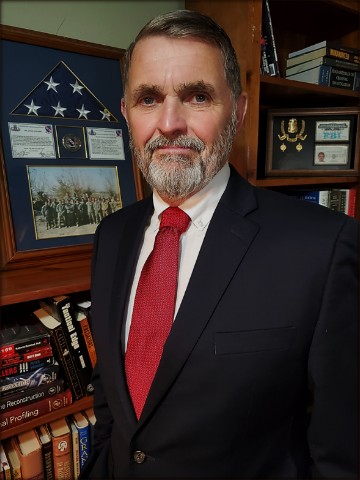 Consultant
Forty years of investigative casework, from patrolman in St. Louis County to the FBI in Chicago, and on to task forces in Afghanistan and Liberia. His work on the Idaho student murders is examined in Broken Plea, the New York Times bestseller by Christopher Whitcomb.
Full profileNever excluded. Professor Gilbertson’s testimony has not been excluded at trial in any state or federal court.
The Hon. Richard A. Jones United States District Judge“Mr. Gilbertson’s qualifications demonstrate extensive experience in policing. His expansive work as a police officer in Georgia, with assignments as a SWAT team officer, juvenile court investigator, school resource officer, stakeout squad officer, senior patrolman, and patrolman; then a career as a tenured college professor and university lecturer teaching criminal justice courses to degree-seeking students at colleges and universities, and as a licensed private investigator conducting felony pretrial investigations for attorneys in Washington State in dozens of criminal cases, makes him unique in the field of police expert witnesses. The Court finds that, based on his experience, Mr. Gilbertson’s testimony can be expected to have a reliable basis in knowledge and experience of police practices.”
What a professionally run internal affairs process looks like.
Internal affairs review is administrative, but the national reference points for doing it well are not obscure. IACP model policies, CALEA accreditation standards and state POST commissions describe the same recognizable architecture: complaints get in, investigations start promptly, evidence is collected while it still exists, everyone with knowledge is interviewed, findings engage the evidence, and dispositions follow the findings. An agency does not need to be large to meet that baseline. It needs to be willing.
- Intake that accepts complaints from any source, in any form, without screening them out at the counter
- Timely assignment to an investigator with the authority and independence to pursue the allegation
- Evidence collection with the same rigor as a criminal case: video, photographs, records and scene material gathered while they exist
- Interviews of every witness with relevant knowledge, civilian and officer alike
- Findings that engage the assembled evidence rather than restating the involved officer’s account
- Dispositions, and any discipline, that follow from the findings and the agency’s own rules
Each element leaves a documentary trace, which is what makes the standard useful in litigation rather than aspirational. The file either contains the intake record or it does not. Assignment either happened promptly or the dates show it did not. The video either was pulled before the retention window lapsed or the file explains why not. A reader does not have to take the agency’s word for any of it; the file testifies about its own investigation.
The rigor phrase deserves emphasis. A professional administrative investigation collects evidence the way a competent criminal investigation would: promptly, completely, with documented handling. The consequences differ between the two tracks; the method should not. When an agency applies a lower evidentiary standard to its own officers than it applies to the public it investigates, that difference is visible in the file, and it is a practices fact.
The disposition vocabulary, and what each finding means.
Internal affairs findings resolve into a small standard vocabulary, and the terms are narrower than their everyday sound. Reading a file, or a decade of files, starts with using them precisely.
- Sustained: the evidence establishes that the conduct occurred and that it violated policy
- Not sustained: the evidence is insufficient to prove or disprove the allegation
- Exonerated: the conduct occurred, but the investigation found it lawful and within policy
- Unfounded: the evidence establishes that the alleged conduct did not occur
The vocabulary does analytical work in a single case. An exonerated finding concedes the conduct and defends it; an unfounded finding denies the conduct happened at all. Those are different factual positions resting on different evidence, and a file that uses the labels interchangeably, or resolves a serious allegation as unfounded without interviewing the civilian witnesses who say it happened, is telling the reader something about the investigation behind the label.
The vocabulary also does work in the aggregate. Dispositions across years form a distribution: which kinds of allegations get sustained, which are routinely not sustained on officer-versus-civilian credibility alone, and whether force allegations meet a different rigor than paperwork violations. That distribution is a record of practice in its own right, read at practices level, and it feeds organizational analysis when a case reaches supervision and discipline.
Labels vary at the margins between agencies, and some add categories for policy failure or informal resolution. The file’s own definitions control the reading; the four-term core is close to universal.
Compelled statements, and how they shape the file.
Garrity v. New Jersey, 385 U.S. 493 (1967) sits underneath every internal affairs interview of an officer. Stated as a practices fact: an officer can be ordered to answer questions in an administrative investigation, with refusal treated as insubordination, and a statement compelled that way is protected against use in a criminal prosecution of that officer. Administrative and criminal tracks are therefore kept separate, and a professionally built file shows the separation on its face.
The practical consequences are visible in the documents. Compelled interviews sit behind written Garrity advisements, and the file shows who gave them and when. Where a parallel criminal investigation exists, the file shows how the compelled material was walled off from it. And the compelled statement is often the most complete account the officer ever gives, taken closer in time to the event than any deposition, which is why the administrative file is sometimes richer than the criminal one.
The boundary is firm. How a Garrity-protected statement may or may not be used in any particular proceeding is a legal question, and it is counsel’s lane; the analysis does not go there. What the expert reads is what the statement contributed to the investigation, whether the advisement practice followed the agency’s own policy, and what the handling says about the professionalism of the process. The term itself, and the file markers that signal it, are covered in what is a Garrity statement.
What the analysis looks for inside an IA file.
The review asks three questions. Did the investigation gather what was gatherable while it was gatherable: video pulled before overwrite, scene material secured, every witness contacted, records requested. Do the findings track the evidence actually assembled, or do they arrive at a disposition the evidence does not carry. And what does the file say about the agency as a system: how supervision responded, whether discipline followed the findings, and whether this officer’s file connects to a longer history the agency held all along.
- Whether video and audio that existed were collected before retention windows lapsed
- Whether civilian witnesses were identified, contacted and interviewed, with non-cooperation documented rather than assumed
- Whether the involved officers’ accounts were tested against the recorded material, not merely transcribed
- Whether each allegation received its own finding, supported by cited evidence
- Whether discipline, where imposed, matches the finding and the agency’s own disciplinary framework
- Whether repeat allegations against the same officer were connected, or handled as if each arrived new
A single file answers a single incident. A run of files answers a different question: whether the agency investigates itself the same way every time, and where its tolerance actually sits. That reading feeds supervision and discipline analysis directly, and it feeds the early warning picture too: complaint intake is the raw material early warning systems count, so an agency that quietly screens complaints out at the counter is also blinding its own alerting system.
The written products inside the file get the same scrutiny as the investigative steps. Investigator summaries are compared against the interview recordings they summarize, and findings memoranda are checked for whether they engage the hard evidence or navigate around it. The failure patterns familiar from incident paperwork appear in administrative files as well; how police reports fail catalogs them.
Practices opinions, and where they stop.
The opinion measures the investigation against national standards and the agency’s own policy: what was gathered and what was not, whether findings engage the evidence, how the process compares to generally accepted practice. It does not resolve witness credibility, does not declare what truly happened in the underlying incident, and does not pronounce on liability. Legal conclusions remain counsel’s; the expert addresses police practices, and says so on the record.
In litigation, the file review typically supports misconduct and supervision theories. A deficient investigation of a serious allegation is itself a fact about the agency, separate from the incident it failed to investigate, and a pattern of deficient investigations is a fact about practice. How those facts fit the elements of any claim or defense is counsel’s architecture, built on a record the analysis has made precise.
The read is the same in both directions. An IA file showing prompt assignment, complete collection, tested accounts and findings that track the evidence is affirmative evidence of a functioning accountability process, and when the record shows that, the report says that. The same standards apply whether the retention comes from plaintiff’s counsel, the defense of an officer or agency, or the criminal defense bar.
When the question becomes a retention.
This page is reference. When a live matter needs the analysis, these are the doors.
Adjacent reading.
Asked alongside this one.
What are the standard internal affairs dispositions?
What standards govern an internal affairs investigation?
What does a police practices expert look for in an IA file?
Bring the matter behind the question.
Attorney inquiries are answered directly. If a case presents a conflict, you will hear it immediately.
Inquiry sent.
You will hear back directly. If the matter is urgent, call (239) 571-1840.
Conflicts are checked before any substantive discussion. Please do not send privileged material with a first inquiry; after retention the record is exchanged on physical media. Gregory consults for attorneys and their staff only, and does not provide legal advice or attorney referrals to individuals.