

Pursuit Policy Standards,
Start, Continue, Terminate
Direct line: (239) 571-1840 · GregoryGilbertson@proton.me
Attorney and law-firm inquiries only
A vehicle pursuit is a decision renewed second by second at speed. National pursuit policy governs three calls, initiation, continuation and termination, and assigns a supervisor to weigh each one while it is being made. The record shows whether that actually happened.
Three experts. Over 110 years.
Professor Gregory Gilbertson (Ret.), FBI Special Agent Christopher Holland (Ret.), and Sheriff Robert Snaza consult with attorneys nationwide regarding police practices and procedures, use of force, false arrest, police misconduct, criminal, and self-defense casework.
 CEO & Owner
Thirty-eight years in four uniforms: street cop, soldier, professor, investigator. More than 220 matters in 42 states and D.C. since 2014, with testimony that has not been excluded at trial in any state or federal court.
Full biography Consultant
More than thirty-five years in public safety: twelve years and three terms as the elected Sheriff of Lewis County, Washington, and six years a commissioner of the state board that sets peace-officer training standards.
Full profile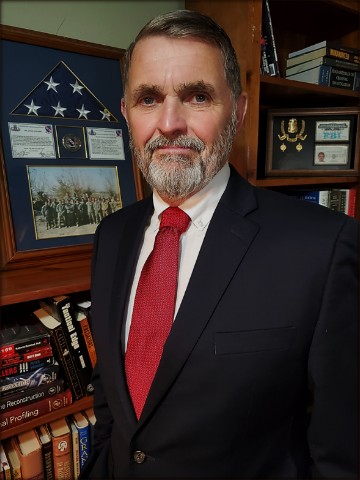 Consultant
Forty years of investigative casework, from patrolman in St. Louis County to the FBI in Chicago, and on to task forces in Afghanistan and Liberia. His work on the Idaho student murders is examined in Broken Plea, the New York Times bestseller by Christopher Whitcomb.
Full profileNever excluded. Professor Gilbertson’s testimony has not been excluded at trial in any state or federal court.
The Hon. Richard A. Jones United States District Judge“Mr. Gilbertson’s qualifications demonstrate extensive experience in policing. His expansive work as a police officer in Georgia, with assignments as a SWAT team officer, juvenile court investigator, school resource officer, stakeout squad officer, senior patrolman, and patrolman; then a career as a tenured college professor and university lecturer teaching criminal justice courses to degree-seeking students at colleges and universities, and as a licensed private investigator conducting felony pretrial investigations for attorneys in Washington State in dozens of criminal cases, makes him unique in the field of police expert witnesses. The Court finds that, based on his experience, Mr. Gilbertson’s testimony can be expected to have a reliable basis in knowledge and experience of police practices.”
Initiation, continuation and termination.
Pursuit is among the most dangerous discretionary decisions in policing, and the risk falls on everyone near it: uninvolved drivers and passengers, pedestrians, the officers, and the person fleeing. National policy responded by channeling the discretion into three named decision points, each with stated criteria, so that a pursuit is never a single choice made once and ridden to its end.
Initiation
The initiation question is what offense and what risk. Policies weigh the seriousness of the suspected offense against the danger the pursuit itself will create, and they weigh it before the pursuit exists. Conditions count from the first second: speeds, traffic density, weather, lighting, and where the pursuit will run. Where the driver is identified and can be apprehended later, that fact weighs against starting at all, because apprehension deferred is risk avoided.
Continuation
Continuation is not a decision made once. Policy requires the risk-versus-need balance to be run continuously as conditions change: speeds climb, traffic thickens, the route approaches pedestrians, a school zone or an intersection sequence that raises the stakes. A pursuit that was defensible at initiation can become indefensible three minutes later without anyone making a new mistake; the conditions changed, and the policy question is whether anyone re-weighed them.
Termination
Termination has two forms: who may call it, and when policy requires it. The pursuing officer may always terminate. Supervisors are empowered to order termination, and policies define conditions in which termination is mandatory rather than discretionary. Termination is also a practice, not just a word on the radio: shutting down emergency equipment, visibly breaking off, and reporting position, so the record shows the pursuit actually ended when the order was given.
The three-decision structure is what makes a pursuit reviewable at all. Each decision has an owner, a moment, and stated criteria, which means each can be located in the record and measured against policy. A pursuit case is rarely about whether pursuing is ever permissible; it is about whether these three decisions were made, by the people the policy assigns them to, on the facts available at the time.
The supervisor is the load-bearing element.
National pursuit policy does not leave the balancing to the driver’s seat. It assigns the supervisor an active role: acknowledge the pursuit promptly, take control of the radio picture, demand the information the balance requires, the offense, the speeds, the traffic, the conditions, and weigh termination continuously from a chair that is not moving at speed.
The radio traffic shows whether that role was performed. A supervisor asking for the reason, the speeds and the conditions is a supervisor weighing risk in real time. A supervisor who acknowledges and goes silent, or who is first heard from after the collision, is a fact about how the pursuit was managed, and the analysis states that fact from the recording without dressing it up.
The same recording protects a supervisor who did the job. A radio record of prompt acknowledgment, pointed questions and a termination order given when the balance tipped is strong evidence of managed risk, and the analysis documents it as such. Both directions get the same treatment, because the standard is the policy’s, not the retaining party’s.
The supervision question also runs past the single incident. Pursuits generate reviewable events, and an agency’s handling of them, reviews conducted or skipped, discipline imposed or not, patterns tracked or ignored, is part of the practices picture. The Library guide to early warning systems and supervision covers how agencies are expected to see their own patterns.
In a pursuit record, supervisory silence is itself a finding. The policy assigns an active role, and the radio either shows it being performed or it does not.
What a pursuit leaves behind.
Pursuits are among the best-documented events in policing, which is what makes them tractable for practices analysis. The dispatch system logs units and times. The radio carries the pursuit as it happened, including what the supervisor said and did not say. Dash and airborne video carry speeds, spacing and traffic in frame. And the agency’s own after-action review states what the agency itself concluded.
- Computer-aided dispatch entries fixing units, times and status changes
- Radio traffic, including supervisory acknowledgments, questions and orders
- Dash and airborne video, with speeds, spacing and traffic conditions in frame
- Body-worn video from the termination point forward
- The involved officers’ pursuit reports and any supervisor’s report
- The agency’s own pursuit review and its findings
- The pursuit policy in force that day, and training records on it
Scott v. Harris, 550 U.S. 372 (2007) placed recorded video at the center of pursuit litigation, and the practices method matches that reality: where the record contains video, the analysis is anchored to it. The narrative reports are measured against the footage rather than the other way around.
The agency’s own review matters twice. Its findings are evidence of what the agency concluded when it looked at its own pursuit, and its silences are evidence of what the agency chose not to examine. An after-action review that never addresses the continuation decisions or the supervisor’s role says something about supervision and training before anyone offers an opinion.
Reading that record is detail work. Speeds are taken where the record states them or shows them, not estimated to fill gaps. Intervals between radio transmissions are measured, because the space between a question and its answer is often where a continuation decision lived. Where the record is genuinely silent on a condition the policy made relevant, the analysis says the record is silent rather than supplying an assumption.
Policy, training and the totality of the pursuit.
The pursuit is measured in layers. First against the agency’s own policy in force on the date, because that is the standard the agency set for itself. Then against the officer’s documented training on that policy. Then against national practice: IACP model policies and the national training curricula that frame what generally accepted police practices require of initiation, continuation, termination and supervision.
The mechanics are chronological. Radio, dispatch entries and video are merged onto a single clock using the method described in building the record chronology, so that each continuation decision can be located in time with the facts then audible and visible: what the pursuing officer had just reported, what the supervisor had just heard, what the video shows the conditions were at that moment.
The training layer matters because a policy nobody was trained on is a document, not a practice. Training records show whether the involved officers and the supervisor were taught the policy’s decision points, and in-service records show whether the agency kept that training current. A gap between a well-written policy and the training behind it is a finding in its own right, and it points at the agency rather than the driver’s seat.
The analysis runs in both directions, on the totality of the facts and circumstances. A pursuit initiated within policy, balanced continuously as conditions changed, and terminated when the balance demanded it is documented as exactly that, and the report says so on the record. The same chronology that exposes an unmanaged pursuit protects a managed one.
Scoping a pursuit matter.
The record request drives the engagement. The dispatch data, the full radio traffic, every camera, the pursuit reports, the policy in force on the date, the training records on that policy, and the agency’s own review, in whatever form it took, are the working file. Gaps in that set are themselves findings: a pursuit with no supervisor’s report, or a review that was never conducted, is a fact about the agency’s practice.
Professor Gilbertson has consulted in more than 220 civil rights and criminal cases across 42 states and the District of Columbia, retained by plaintiff’s counsel, by the criminal defense bar, and by counsel defending officers and agencies. On a pursuit question the opinion addresses practices: what the policy required at each decision point, what the record shows was done, and where they diverge. Whether the pursuit gives rise to liability is a legal conclusion, and legal conclusions remain counsel’s.
For a first inquiry, the posture and what the record already holds are enough: whether the dispatch data, radio and video have been produced, and whether the agency’s own pursuit review exists. Nothing privileged is needed to scope the engagement.
When the question becomes a retention.
This page is reference. When a live matter needs the analysis, these are the doors.
Asked alongside this one.
What do national pursuit policy standards require before a pursuit begins?
What role does a supervisor play during a police pursuit?
What record shows whether a pursuit followed policy?
Bring the matter behind the question.
Attorney inquiries are answered directly. If a case presents a conflict, you will hear it immediately.
Inquiry sent.
You will hear back directly. If the matter is urgent, call (239) 571-1840.
Conflicts are checked before any substantive discussion. Please do not send privileged material with a first inquiry; after retention the record is exchanged on physical media. Gregory consults for attorneys and their staff only, and does not provide legal advice or attorney referrals to individuals.