

The agency graded the force.
The grade is evidence.
Direct line: (239) 571-1840 · GregoryGilbertson@proton.me
Attorney and law-firm inquiries only
A use-of-force review board is the agency’s own after-action judgment on a force incident. Its file shows what the agency saw, what it concluded, and what it did next. In supervision and pattern litigation, each of those is evidence about the organization, not just the officer.
Three experts. Over 110 years.
Professor Gregory Gilbertson (Ret.), FBI Special Agent Christopher Holland (Ret.), and Sheriff Robert Snaza consult with attorneys nationwide regarding police practices and procedures, use of force, false arrest, police misconduct, criminal, and self-defense casework.
 CEO & Owner
Thirty-eight years in four uniforms: street cop, soldier, professor, investigator. More than 220 matters in 42 states and D.C. since 2014, with testimony that has not been excluded at trial in any state or federal court.
Full biography Consultant
More than thirty-five years in public safety: twelve years and three terms as the elected Sheriff of Lewis County, Washington, and six years a commissioner of the state board that sets peace-officer training standards.
Full profile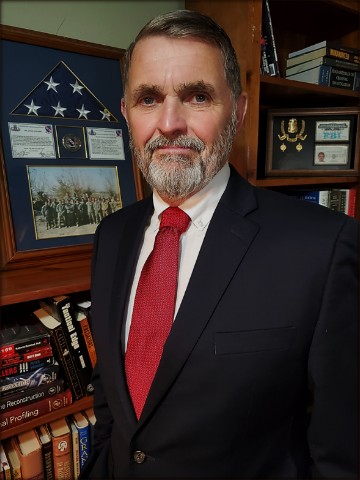 Consultant
Forty years of investigative casework, from patrolman in St. Louis County to the FBI in Chicago, and on to task forces in Afghanistan and Liberia. His work on the Idaho student murders is examined in Broken Plea, the New York Times bestseller by Christopher Whitcomb.
Full profileNever excluded. Professor Gilbertson’s testimony has not been excluded at trial in any state or federal court.
The Hon. Richard A. Jones United States District Judge“Mr. Gilbertson’s qualifications demonstrate extensive experience in policing. His expansive work as a police officer in Georgia, with assignments as a SWAT team officer, juvenile court investigator, school resource officer, stakeout squad officer, senior patrolman, and patrolman; then a career as a tenured college professor and university lecturer teaching criminal justice courses to degree-seeking students at colleges and universities, and as a licensed private investigator conducting felony pretrial investigations for attorneys in Washington State in dozens of criminal cases, makes him unique in the field of police expert witnesses. The Court finds that, based on his experience, Mr. Gilbertson’s testimony can be expected to have a reliable basis in knowledge and experience of police practices.”
An internal board, judging force against policy.
A use-of-force review board is an internal panel that examines a force incident after the fact and measures it against agency policy, training and tactics. It is not a criminal investigation, and it is not a complaint file. The board asks a narrower administrative question: judged by this agency’s own written standards, was the force within policy, and what should change if it was not.
The board is distinct from internal affairs. An IA investigation typically opens on a complaint of misconduct against an identified officer and aims at a disciplinary finding. A review board convenes on the incident itself, often whether or not anyone complained, and evaluates decision-making, tactics, supervision and policy fit as an organizational matter. The two tracks produce different files, and litigation should collect both.
Composition and thresholds vary by agency, and the variation is itself a litigation fact. Some boards seat command staff only; others add trainers, defensive-tactics instructors or peer officers. Some agencies board every reportable use of force; others convene only for serious incidents such as officer-involved shootings, or when a supervisor flags the case. National standards and model policies from bodies such as IACP and PERF inform what a sound administrative force-review process generally looks like, but the first question in any case is what this agency’s own policy required, and whether the agency followed its own rule.
Outcomes are usually framed administratively: within policy, out of policy, or within policy with tactical or training concerns. Boards can also route an incident to a training referral, a policy review or a separate disciplinary process. Those routing decisions, and whether anyone tracked them to completion, become the record of what the agency did with what it learned.
What board records show in litigation.
Board records answer four questions that no other document answers as directly. Did the agency review the incident at all? What did it conclude? Did the conclusion track the evidence in front of the board? And what changed afterward: training, policy, supervision or discipline.
Each answer is a fact about the organization. A board that found the force within policy while the video shows a violation of that policy is direct evidence of how the agency actually grades its officers. A critical finding followed by no retraining, no policy change and no discipline is evidence of what the agency does with its own warnings. Non-response after a critical finding is itself a fact, dated and documented, and an opinion can be anchored to it.
What to demand in discovery.
- The board’s findings memo for the incident at issue, with the vote or disposition
- Meeting minutes, presentation materials and the evidence packet the board actually reviewed
- Training referrals, policy recommendations and corrective-action memos that followed the finding
- Prior board findings on the same officer and on the same tactic
- The written policy setting the board’s composition, thresholds and timelines
- Any tracking of whether recommended corrections were completed
If policy required a board and the agency cannot produce a file, that absence is discoverable, and it is evidence of organizational practice.
Board records as organizational evidence.
In the expert analysis, board files are organizational evidence. They sit alongside training records, complaint histories and early-warning data in supervision, training and pattern review, and they are measured against national standards and model policies that describe generally accepted administrative force review.
The comparison that matters runs between what the board concluded and what the raw record supports. A single generous finding proves little. Repeated findings that bless force the video, statements and reports do not support show how the organization actually supervises, and that gap feeds pattern, practice and custom analysis under Monell v. Department of Social Services, 436 U.S. 658 (1978). The documents that build that showing are collected in the Monell record checklist, and the casework itself runs through supervision and discipline analysis.
Board outcomes should also land in the agency’s early-warning system alongside complaints, pursuits and other performance indicators; whether they actually do is a supervision fact worth checking in every case.
The same file serves the defense. Where a board pressed hard questions, documented its reasoning and drove corrections that were completed, the record shows an agency supervising in earnest, and the report says so. The complaint-driven track that runs parallel to the board is covered in the explainer on internal affairs review standards.
The boundary holds here as it does everywhere in the practice: the opinion addresses police practices, supervision and training. Whether those facts establish municipal liability is a legal conclusion, and legal conclusions remain counsel’s.
When the question becomes a retention.
This page is reference. When a live matter needs the analysis, these are the doors.
Asked alongside this one.
Is a use-of-force review board the same as internal affairs?
What if the agency never convened a board after a serious incident?
Can board findings support a Monell pattern claim?
Bring the matter behind the question.
Attorney inquiries are answered directly. If a case presents a conflict, you will hear it immediately.
Inquiry sent.
You will hear back directly. If the matter is urgent, call (239) 571-1840.
Conflicts are checked before any substantive discussion. Please do not send privileged material with a first inquiry; after retention the record is exchanged on physical media. Gregory consults for attorneys and their staff only, and does not provide legal advice or attorney referrals to individuals.