

POST certification,
and what decertification means.
Direct line: (239) 571-1840 · GregoryGilbertson@proton.me
Attorney and law-firm inquiries only
Nearly every state now runs a commission that sets minimum standards for who may serve as a police officer and issues the certification that state law ties to that service. This page states what that credential is, what removing it involves, and why certification history shows up in hiring, retention and training claims.
Three experts. Over 110 years.
Professor Gregory Gilbertson (Ret.), FBI Special Agent Christopher Holland (Ret.), and Sheriff Robert Snaza consult with attorneys nationwide regarding police practices and procedures, use of force, false arrest, police misconduct, criminal, and self-defense casework.
 CEO & Owner
Thirty-eight years in four uniforms: street cop, soldier, professor, investigator. More than 220 matters in 42 states and D.C. since 2014, with testimony that has not been excluded at trial in any state or federal court.
Full biography Consultant
More than thirty-five years in public safety: twelve years and three terms as the elected Sheriff of Lewis County, Washington, and six years a commissioner of the state board that sets peace-officer training standards.
Full profile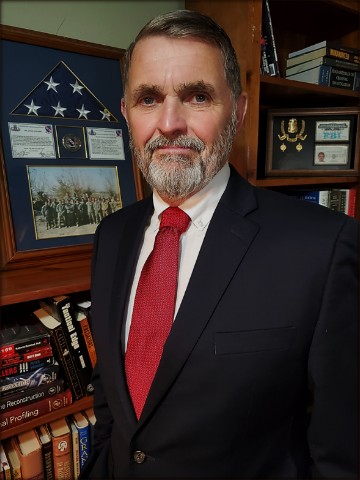 Consultant
Forty years of investigative casework, from patrolman in St. Louis County to the FBI in Chicago, and on to task forces in Afghanistan and Liberia. His work on the Idaho student murders is examined in Broken Plea, the New York Times bestseller by Christopher Whitcomb.
Full profileNever excluded. Professor Gilbertson’s testimony has not been excluded at trial in any state or federal court.
The Hon. Richard A. Jones United States District Judge“Mr. Gilbertson’s qualifications demonstrate extensive experience in policing. His expansive work as a police officer in Georgia, with assignments as a SWAT team officer, juvenile court investigator, school resource officer, stakeout squad officer, senior patrolman, and patrolman; then a career as a tenured college professor and university lecturer teaching criminal justice courses to degree-seeking students at colleges and universities, and as a licensed private investigator conducting felony pretrial investigations for attorneys in Washington State in dozens of criminal cases, makes him unique in the field of police expert witnesses. The Court finds that, based on his experience, Mr. Gilbertson’s testimony can be expected to have a reliable basis in knowledge and experience of police practices.”
What a POST commission is, and what it certifies.
POST stands for Peace Officer Standards and Training. Nearly every state maintains a commission or council of that kind, under one name or another, and the core function is similar: it sets minimum standards a person must meet to serve as a peace officer, and it issues, suspends or withdraws the certification state law ties to that service. Beyond that core the structure varies. Some commissions approve the basic academy curriculum and some do not, some states run more than one such body, and the authority to exercise police powers comes from appointment by the employing agency under state law rather than from the certificate itself. The commission is a state body, separate from the employing agency, and it holds records the agency does not.
What the standards actually require varies by state, and the analysis never assumes otherwise. Minimum selection criteria, academy length and content, field training expectations, in-service requirements and the process for maintaining a credential are all set jurisdiction by jurisdiction. The practices question is never what a national rule requires. It is what this state’s commission required at the relevant time, and whether the officer and the agency met it.
What a commission typically holds on an officer.
- The certification record itself: when issued, its current status, and any lapse or reinstatement
- Basic academy attendance and completion, and the academy that delivered it
- Instructor certifications and specialty credentials the officer earned
- In-service and continuing training reported by employing agencies
- Employment separations reported by agencies, and the reason each reported
- Any commission action taken against the credential, including its outcome
Commission records and agency training files are two different collections, and they do not always agree. The disagreement itself is sometimes the finding, which is why both are requested rather than one standing in for the other.
Decertification, and the national registry.
Decertification is the commission’s removal of an officer’s peace officer certification, which ends the individual’s ability to serve in that role in that state. It is an administrative action taken by the state, distinct from an agency’s decision to fire someone and distinct from any criminal case arising from the same conduct. An officer can be terminated without being decertified, and can be acquitted or never charged and still lose the credential.
The grounds and the process vary by state, and so does the reach: what conduct triggers a proceeding, who may initiate it, what appeal rights attach, and whether the outcome is publicly reported are jurisdiction-specific questions counsel confirms for the state in issue. The analysis works from the records the commission and the agency actually produced rather than from assumptions about how a given state runs its process.
The National Decertification Index, and what a hit means.
- The National Decertification Index (NDI) is a national registry of certification actions that agencies can query during background screening
- A hit indicates that a reporting state took an action against a credential, and points the inquiry to that state’s records
- A hit is not the underlying record: the finding, the conduct and the outcome live with the reporting commission
- No hit is not a clean history, because what gets reported to the registry depends on state reporting practice
- The screening question in litigation is whether the hiring agency queried what was available to it, and what it did with the answer
Why certification history shows up in litigation.
Certification records enter a case through two doors. The first is hiring and retention: what the agency knew or could readily have learned about an applicant’s prior separations, credential status and commission actions, what it asked, and whether it hired or kept the officer anyway. That is the record examined in hiring and retention casework, and it is often the most document-heavy part of an organizational theory.
The second door is training adequacy. Commission requirements set a floor, and meeting the floor is not the same as training an officer for the task the incident actually presented. The comparison that matters is between what the officer was trained to do, what policy required, and what the officer did, which is the analysis a failure to train expert performs against City of Canton v. Harris, 489 U.S. 378 (1989), and Monell v. Department of Social Services, 436 U.S. 658 (1978), theories built by counsel. What those files reveal in practice is covered in what training records reveal.
Certification is an individual credential; agency accreditation is a separate voluntary process examined in what CALEA accreditation is. Neither answers the ultimate question. The opinion addresses police practices: what the standards required, what the records show, and where the two part company. Whether that supports liability is a legal conclusion, and legal conclusions remain counsel’s.
When the question becomes a retention.
This page is reference. When a live matter needs the analysis, these are the doors.
Asked alongside this one.
Is decertification the same as being fired?
What does a National Decertification Index hit tell a hiring agency?
Which certification records should counsel request in discovery?
Bring the matter behind the question.
Attorney inquiries are answered directly. If a case presents a conflict, you will hear it immediately.
Inquiry sent.
You will hear back directly. If the matter is urgent, call (239) 571-1840.
Conflicts are checked before any substantive discussion. Please do not send privileged material with a first inquiry; after retention the record is exchanged on physical media. Gregory consults for attorneys and their staff only, and does not provide legal advice or attorney referrals to individuals.