

What CALEA accreditation is,
and what it proves.
Direct line: (239) 571-1840 · GregoryGilbertson@proton.me
Attorney and law-firm inquiries only
CALEA accreditation surfaces in most failure-to-train matters, usually as a credential one side wants to lean on. This page states what the accreditation actually measures, what it proves and does not prove about conduct in the field, and how it enters a police practices analysis.
Three experts. Over 110 years.
Professor Gregory Gilbertson (Ret.), FBI Special Agent Christopher Holland (Ret.), and Sheriff Robert Snaza consult with attorneys nationwide regarding police practices and procedures, use of force, false arrest, police misconduct, criminal, and self-defense casework.
 CEO & Owner
Thirty-eight years in four uniforms: street cop, soldier, professor, investigator. More than 220 matters in 42 states and D.C. since 2014, with testimony that has not been excluded at trial in any state or federal court.
Full biography Consultant
More than thirty-five years in public safety: twelve years and three terms as the elected Sheriff of Lewis County, Washington, and six years a commissioner of the state board that sets peace-officer training standards.
Full profile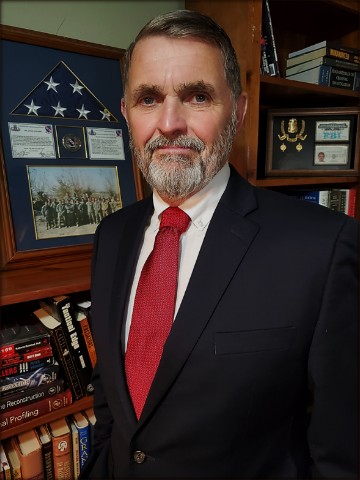 Consultant
Forty years of investigative casework, from patrolman in St. Louis County to the FBI in Chicago, and on to task forces in Afghanistan and Liberia. His work on the Idaho student murders is examined in Broken Plea, the New York Times bestseller by Christopher Whitcomb.
Full profileNever excluded. Professor Gilbertson’s testimony has not been excluded at trial in any state or federal court.
The Hon. Richard A. Jones United States District Judge“Mr. Gilbertson’s qualifications demonstrate extensive experience in policing. His expansive work as a police officer in Georgia, with assignments as a SWAT team officer, juvenile court investigator, school resource officer, stakeout squad officer, senior patrolman, and patrolman; then a career as a tenured college professor and university lecturer teaching criminal justice courses to degree-seeking students at colleges and universities, and as a licensed private investigator conducting felony pretrial investigations for attorneys in Washington State in dozens of criminal cases, makes him unique in the field of police expert witnesses. The Court finds that, based on his experience, Mr. Gilbertson’s testimony can be expected to have a reliable basis in knowledge and experience of police practices.”
What CALEA accreditation actually is.
CALEA accreditation is a voluntary national program for law enforcement agencies. An agency that pursues it writes its directives to published standards, documents that it follows them, and submits to review by outside assessors on a recurring cycle. Nothing compels an agency to seek accreditation. Many capable departments never apply, and some accredited agencies later let the status lapse.
The unit of measurement is the written directive. Standards are framed around what an agency must have in writing and be able to produce on request: a use-of-force policy, a complaint intake and internal review process, training documentation, evidence handling, supervisory review. Compliance is shown with files rather than impressions, which is why an accreditation file is often the cleanest inventory of an agency’s own rules that exists anywhere.
What the process asks an agency to show.
- Written directives covering the core operational areas, current and dated
- Evidence that officers received those directives and acknowledged them
- Training records that tie instruction back to the governing policy
- A working complaint intake, investigation and review process
- Documentation that supervisory review happened, not merely that it was required
- Reassessment on a cycle rather than a single one-time filing
Accreditation is not the only marker of this kind. State POST commissions set the requirements that let an individual officer work at all, and federal academy accreditation through FLETA runs a parallel process on the training side. Those are separate systems measuring separate things, and what POST certification means covers the individual side of the ledger.
What accreditation proves, and what it does not.
Accreditation establishes that an agency chose to be measured against national standards and can produce the paper to show for it. That is a real finding, and it is a narrow one. Written policy is one layer of practice; supervision and training are the layers that decide whether the policy operates. How those layers interact is the subject of policy, practice and training.
A current accreditation file establishes what an agency told its officers to do. It does not establish what they did on the day in question.
Both directions matter in litigation, and neither is decisive. An accredited agency is charged with knowing its own standards: it adopted them, published them, trained to them and told an outside body it was complying. Where the record shows conduct diverging from a directive the agency wrote and was reviewed on, the gap is documented rather than argued.
The reverse inference does not hold. An agency without accreditation has not thereby fallen below the standard of care, and no opinion should suggest that the absence of a voluntary credential is itself a deficiency. Unaccredited agencies still answer to generally accepted police practices, which do not depend on participation in any program.
Accreditation carries weight for the defense for the same reason it carries limits for the plaintiff. It shows an agency that wrote, published, trained and submitted to outside review, which is process discipline and documentary evidence of it. The question that survives either way is whether the directive governed conduct on the date at issue.
How accreditation enters a practices opinion.
In a police practices opinion, accreditation status is one input to the policy-adequacy layer, never the opinion itself. The analysis reads the agency’s directives against IACP model policies, state POST requirements, published curricula from bodies such as PERF, and the practices generally accepted in the field, then compares all of it with what the record shows officers were actually taught and actually did.
What the accreditation file is read for.
- The policy text in force on the date of the incident, with the revisions around it
- Whether the directive matches, exceeds or falls short of national model policy
- Training records showing the directive was taught, not merely adopted
- Complaint, review and discipline records that show the process running
- Any daylight between what the agency reported about itself and what its files show
That last item is where accreditation becomes most useful and most sensitive. An agency’s own compliance representations are records like any other, and where they do not match the training and supervision files, the divergence is documented and left to counsel to use. The organizational side of that work runs through failure to train and supervision analysis.
None of this is an opinion about liability. The analysis addresses police practices: what the standards required, what the agency wrote, what it trained, and what the record shows. Legal conclusions, including what any of it means for a municipality’s exposure, remain counsel’s.
When the question becomes a retention.
This page is reference. When a live matter needs the analysis, these are the doors.
Asked alongside this one.
Does CALEA accreditation mean an agency met the standard of care?
Is an unaccredited agency held to a lower standard?
Where do accreditation records fit in the discovery counsel assembles?
Bring the matter behind the question.
Attorney inquiries are answered directly. If a case presents a conflict, you will hear it immediately.
Inquiry sent.
You will hear back directly. If the matter is urgent, call (239) 571-1840.
Conflicts are checked before any substantive discussion. Please do not send privileged material with a first inquiry; after retention the record is exchanged on physical media. Gregory consults for attorneys and their staff only, and does not provide legal advice or attorney referrals to individuals.