

Every Skill Leaves a Record
So Does Every Skipped One
Direct line: (239) 571-1840 · GregoryGilbertson@proton.me
Attorney and law-firm inquiries only
Training that standardized practice requires leaves paper when it happens and silence where it was skipped. Both are evidence. This page inventories the police training record universe, what each file proves, and how counsel should request it.
Three experts. Over 110 years.
Professor Gregory Gilbertson (Ret.), FBI Special Agent Christopher Holland (Ret.), and Sheriff Robert Snaza consult with attorneys nationwide regarding police practices and procedures, use of force, false arrest, police misconduct, criminal, and self-defense casework.
 CEO & Owner
Thirty-eight years in four uniforms: street cop, soldier, professor, investigator. More than 220 matters in 42 states and D.C. since 2014, with testimony that has not been excluded at trial in any state or federal court.
Full biography Consultant
More than thirty-five years in public safety: twelve years and three terms as the elected Sheriff of Lewis County, Washington, and six years a commissioner of the state board that sets peace-officer training standards.
Full profile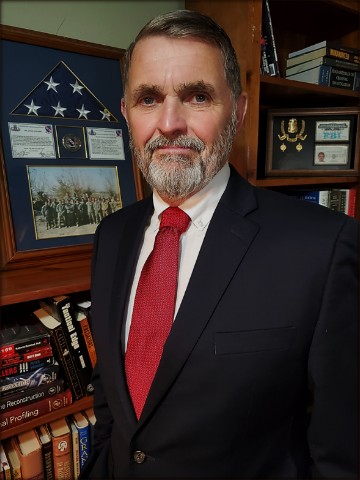 Consultant
Forty years of investigative casework, from patrolman in St. Louis County to the FBI in Chicago, and on to task forces in Afghanistan and Liberia. His work on the Idaho student murders is examined in Broken Plea, the New York Times bestseller by Christopher Whitcomb.
Full profileNever excluded. Professor Gilbertson’s testimony has not been excluded at trial in any state or federal court.
The Hon. Richard A. Jones United States District Judge“Mr. Gilbertson’s qualifications demonstrate extensive experience in policing. His expansive work as a police officer in Georgia, with assignments as a SWAT team officer, juvenile court investigator, school resource officer, stakeout squad officer, senior patrolman, and patrolman; then a career as a tenured college professor and university lecturer teaching criminal justice courses to degree-seeking students at colleges and universities, and as a licensed private investigator conducting felony pretrial investigations for attorneys in Washington State in dozens of criminal cases, makes him unique in the field of police expert witnesses. The Court finds that, based on his experience, Mr. Gilbertson’s testimony can be expected to have a reliable basis in knowledge and experience of police practices.”
The training record universe, item by item.
An officer’s training history is not one document; it is a family of records held by different custodians on different schedules. The inventory below is the working universe for a failure-to-train theory, an individual force case, or the defense of either. Each item exists in some form in nearly every American agency, because standardized practice requires it to.
- Academy transcripts and basic-training curricula
- Field training (FTO) records and daily observation reports
- In-service training histories and hour totals
- Lesson plans, instructor outlines and course handouts
- Instructor certifications and qualifications to teach
- Weapons and skills qualification records
- Remedial training directives and their documentation
- Policy acknowledgment signatures in the personnel file
State-level records sit alongside the agency file. POST commissions maintain their own certification and training histories, and what POST certification covers explains that layer, including decertification records and the National Decertification Index. Requesting both the agency file and the state file is the only way to see whether they agree.
Two habits make the universe manageable. First, request by category rather than by label, because agencies name these files inconsistently: a training jacket in one department is a personnel sub-file in another. Second, avoid narrow date ranges at the start; the value of the file is its whole timeline, and narrowing can come later, once the record’s shape is known.
What each record proves, and what it cannot.
Each record type answers a narrow question well and a broad question badly. The analysis never asks one document to prove more than it can; it stacks the narrow answers until the training picture is complete. Three groupings carry most of the weight.
Academy and field training
The academy transcript establishes the baseline: what the officer was taught at entry, in which subjects, from which curriculum. Field training records show the supervised transition to the street, phase by phase, with evaluator commentary that often speaks more candidly about actual practice than any later document. Daily observation reports are worth reading in full, because they record how the recruit actually performed the skills the academy taught on paper. Together these files answer the first question in any training theory: was the technique at issue ever taught at all.
In-service and qualifications
In-service records establish recency and currency: whether perishable skills were refreshed, whether new policies arrived with training behind them, and whether mandated subjects actually ran. Qualification records show a skill was demonstrated to a standard rather than merely attended. Currency matters because skills and standards both move; a technique taught once at entry and never refreshed is a different fact from one refreshed on cycle, and the file dates both.
Lesson plans, instructors and acknowledgments
Lesson plans and curricula are the content record: what the class actually contained, which scenarios ran, what the handouts said. Instructor certifications show who was qualified to teach the block and in what discipline; where an outside vendor taught it, the contract and course materials join the same record. Remedial training documentation shows the agency identified a deficiency and did, or did not, close it. Policy acknowledgments prove distribution of a rule, and nothing more.
Silence in the file is a finding.
Training that standardized practice requires leaves records when it is done. Rosters are kept, hours are logged, qualification scores are filed, because accreditation standards, state POST rules and the agency’s own policies require the paper. That is what makes absence probative: where the requirement is documented and the record is silent, the silence is not a gap in discovery, it is the finding.
The analysis pairs every absence with its requirement. An empty in-service file matters where policy or a state mandate required the subject on a cycle. A missing lesson plan matters where the agency claims the training occurred. No qualification record matters where policy conditions carrying the weapon on qualifying with it. Absence without a documented requirement is noted honestly as inconclusive; absence against a documented requirement is stated as what it is.
Records management rules keep the absence analysis fair. Agencies operate under retention schedules for training documentation, and the analysis accounts for them: a record lawfully destroyed on schedule is a different fact from a record that should exist and does not. The report distinguishes the two, which is exactly what makes a silent-file finding durable under cross-examination.
The same logic protects agencies with clean files. A complete, dated, curriculum-backed training history is affirmative evidence that the agency trained what it wrote, and the analysis says so with the same directness when retained for the defense. The file testifies either way; the method is identical.
Request the curriculum, not just the roster.
The most common discovery mistake in training litigation is stopping at attendance. A sign-in sheet proves presence, not content. Counsel who holds a roster knows an officer sat in a room; counsel who holds the lesson plan knows what the room contained, what was demonstrated, what was tested, and what the officer was accountable for afterward.
- The complete individual training file for each involved officer, academy to present
- Lesson plans, curricula, presentations and handouts for each course relied on
- Instructor certifications and qualifications for those courses
- In-service calendars and completion reports for the relevant subjects
- Qualification and requalification records for the weapons and techniques at issue
- Remedial training directives and their completion documentation
- Policy acknowledgment records for the policies at issue
- The agency’s training-related policies: what it requires of itself
Form of production matters less than completeness, but ask for records as kept: native files with dates and signatures rather than summaries. A summary of training prepared for litigation is a litigation document; the underlying rosters, plans and scores are the record.
Pair the document demand with a foundation question: ask the agency to identify its own training requirements for the subjects at issue, then match the produced file against the identified requirements. The comparison does the analytic work, and it keeps any silent-file finding anchored to the agency’s own words rather than to an outside benchmark alone.
Sequence matters too. The training file is read against the policy manual and the incident record, which is the three-layer method described at policy, practice and training: policy against national standards, training against policy, practice against both. Requesting all three document families early, from their separate custodians, keeps the layers comparable on one timeline.
How the training record becomes analysis.
In the report, the training file answers concrete questions, each tied to a produced document: was the officer taught the technique at issue; how recently and by what curriculum; did the instructor hold the discipline; did the agency’s training match its own policy; and did both match national standards, IACP model policies, PERF guidance and state POST requirements among them. Where the answers diverge, the report states the divergence and its practices significance.
The organizational reach of those answers runs through failure-to-train and municipal liability doctrine, and that legal territory is counsel’s. The practices analysis supplies its factual architecture: the documented what, when and whether of the agency’s training. Supervision patterns that surface in the same records, missed remediation, unread early-warning flags, are covered at early-warning systems and supervision. Legal conclusions remain counsel’s; the expert addresses police practices.
Rebuttal work uses the same file in reverse. When an opposing expert characterizes an agency’s training as adequate or deficient, the training record either supports the characterization or it does not, and a review of the opposing report starts by re-reading the file it relied on. The documents, not the adjectives, decide whether a characterization survives.
Professor Gilbertson’s reports treat the training record as the spine of organizational analysis because it is the layer the agency controls completely. Policies can be aspirational and incidents can be contested, but the training file is the agency’s own contemporaneous account of what it actually equipped its officers to do. Read carefully, it usually settles the question of what the organization expected, and the report says so on the record.
A training file is discoverable, dated and signed. Few document families in police litigation carry as much settled fact per page, and few are requested as incompletely.
When the question becomes a retention.
This page is reference. When a live matter needs the analysis, these are the doors.
Asked alongside this one.
Which police training records should counsel request in discovery?
What does it mean if an agency has no training records for an officer?
Do attendance rosters prove an officer was trained?
Bring the matter behind the question.
Attorney inquiries are answered directly. If a case presents a conflict, you will hear it immediately.
Inquiry sent.
You will hear back directly. If the matter is urgent, call (239) 571-1840.
Conflicts are checked before any substantive discussion. Please do not send privileged material with a first inquiry; after retention the record is exchanged on physical media. Gregory consults for attorneys and their staff only, and does not provide legal advice or attorney referrals to individuals.