

What tunnel vision is,
and what it leaves in the file.
Direct line: (239) 571-1840 · GregoryGilbertson@proton.me
Attorney and law-firm inquiries only
Tunnel vision is an investigation that commits to one suspect or one theory before the record justifies it, and then treats everything that follows as either confirmation or noise. The commitment is invisible in a case summary. It is visible in the file.
Three experts. Over 110 years.
Professor Gregory Gilbertson (Ret.), FBI Special Agent Christopher Holland (Ret.), and Sheriff Robert Snaza consult with attorneys nationwide regarding police practices and procedures, use of force, false arrest, police misconduct, criminal, and self-defense casework.
 CEO & Owner
Thirty-eight years in four uniforms: street cop, soldier, professor, investigator. More than 220 matters in 42 states and D.C. since 2014, with testimony that has not been excluded at trial in any state or federal court.
Full biography Consultant
More than thirty-five years in public safety: twelve years and three terms as the elected Sheriff of Lewis County, Washington, and six years a commissioner of the state board that sets peace-officer training standards.
Full profile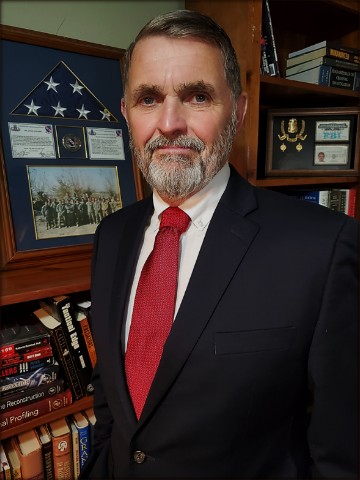 Consultant
Forty years of investigative casework, from patrolman in St. Louis County to the FBI in Chicago, and on to task forces in Afghanistan and Liberia. His work on the Idaho student murders is examined in Broken Plea, the New York Times bestseller by Christopher Whitcomb.
Full profileNever excluded. Professor Gilbertson’s testimony has not been excluded at trial in any state or federal court.
The Hon. Richard A. Jones United States District Judge“Mr. Gilbertson’s qualifications demonstrate extensive experience in policing. His expansive work as a police officer in Georgia, with assignments as a SWAT team officer, juvenile court investigator, school resource officer, stakeout squad officer, senior patrolman, and patrolman; then a career as a tenured college professor and university lecturer teaching criminal justice courses to degree-seeking students at colleges and universities, and as a licensed private investigator conducting felony pretrial investigations for attorneys in Washington State in dozens of criminal cases, makes him unique in the field of police expert witnesses. The Court finds that, based on his experience, Mr. Gilbertson’s testimony can be expected to have a reliable basis in knowledge and experience of police practices.”
Tunnel vision, defined as investigative practice.
Tunnel vision describes a way of working a case, not a state of mind. It occurs when an investigation settles on a suspect or a theory early, and the work that follows narrows to support that choice. Leads that confirm the theory get pursued, corroborated and written into the case narrative. Leads that would undercut it get noted once, deferred, or never worked at all. None of that requires bad faith, and a practices analysis does not assume any. What it examines is the sequence of investigative decisions and whether each one was supported by the information the investigator actually held at the time.
The distinction that matters in review is between focus and premature commitment. Every investigation narrows eventually; that is what a solved case looks like. The question is whether the narrowing followed the evidence or preceded it. An investigation that runs alternatives down, documents the results and then concentrates its resources has focused. An investigation that concentrates first and documents nothing about the alternatives has committed, and the file shows the difference.
The two directions evidence gets filtered.
- Confirming information is collected, corroborated and carried forward into later reports
- Disconfirming information is logged in a supplement and left there without follow-up
- Interviews are built around the theory rather than around what the witness can independently supply
- Evidence collection becomes selective, matched to the account already in hand
- Alternative suspects are set aside with no documented basis for eliminating them
- Successive reports restate the early conclusion rather than test it
What tunnel vision leaves in the file.
Tunnel vision is not identified from the outcome of a case. It is identified from the documentary record the investigation produced, which is why a complete file matters more here than in almost any other review. The signature is consistent across agencies and case types, and every element of it is a records question counsel can put to a witness.
The documentary signature.
- Alternative suspects named in early reports and never eliminated on paper
- Canvass entries and tip sheets with no corresponding follow-up report
- Exculpatory indications recorded once and never revisited in any supplement
- Interview practices that presuppose the answer, including the theory disclosed to the witness before the account is taken
- Identification procedures assembled around the chosen suspect rather than administered neutrally
- A case narrative that tightens over time while the underlying leads stay open
- Supervisory review that approves each report without asking what was not done
Each item is measured against the agency’s own policy and against national standards, model policies and training curricula covering case management, canvass documentation, identification procedures and supervisory review. The analysis does not speculate about motive. It states what the practice was, what generally accepted police practice required, and where the two diverge. The report-level counterpart of this review is treated in how police reports fail, and the scene-level counterpart in crime scene documentation standards.
The most productive question in this review is not what the file contains. It is what the file shows was never done, and whether anything in the record explains the decision not to do it.
Where the question surfaces in litigation.
In post-conviction and wrongful conviction review, tunnel vision is rarely the claim itself. It is the explanation for a set of concrete omissions counsel intends to prove: the witness never interviewed, the alternative suspect never cleared, the item collected but never submitted. The value of a practices analysis is that it converts a pattern into particulars, each one anchored to a document or to the documented absence of one.
The analysis runs the same way for counsel defending an agency. Where the file shows that alternatives were worked and closed on paper, that canvass leads were returned, and that the narrowing followed the evidence, the report says exactly that. That finding carries weight because the same method produces the opposite finding when the record requires it.
Custody and handling questions travel with these reviews, since an item collected and never tracked reads much like an item never collected; that subject is covered in what chain of custody requires. Where scientific, medical or technical questions arise, qualified experts in those disciplines are deferred to on the record. And the ultimate questions, including whether a disclosure obligation was breached under Brady v. Maryland, 373 U.S. 83 (1963), and what relief should follow, are legal conclusions that remain counsel’s. The expert addresses police practices.
When the question becomes a retention.
This page is reference. When a live matter needs the analysis, these are the doors.
Adjacent reading.
Asked alongside this one.
Is tunnel vision an opinion about what an investigator was thinking?
Which records show whether an investigation narrowed too early?
Can this analysis help counsel defending an officer or an agency?
Bring the matter behind the question.
Attorney inquiries are answered directly. If a case presents a conflict, you will hear it immediately.
Inquiry sent.
You will hear back directly. If the matter is urgent, call (239) 571-1840.
Conflicts are checked before any substantive discussion. Please do not send privileged material with a first inquiry; after retention the record is exchanged on physical media. Gregory consults for attorneys and their staff only, and does not provide legal advice or attorney referrals to individuals.