

An early read,
before the complaint is filed.
Direct line: (239) 571-1840 · GregoryGilbertson@proton.me
Attorney and law-firm inquiries only
Preliminary case-merit evaluation is a listed engagement form: a bounded early read of what the available record shows, before counsel commits to filing. Here is what it catches, why the honest no is the point, and how the engagement runs pre-suit.
Three experts. Over 110 years.
Professor Gregory Gilbertson (Ret.), FBI Special Agent Christopher Holland (Ret.), and Sheriff Robert Snaza consult with attorneys nationwide regarding police practices and procedures, use of force, false arrest, police misconduct, criminal, and self-defense casework.
 CEO & Owner
Thirty-eight years in four uniforms: street cop, soldier, professor, investigator. More than 220 matters in 42 states and D.C. since 2014, with testimony that has not been excluded at trial in any state or federal court.
Full biography Consultant
More than thirty-five years in public safety: twelve years and three terms as the elected Sheriff of Lewis County, Washington, and six years a commissioner of the state board that sets peace-officer training standards.
Full profile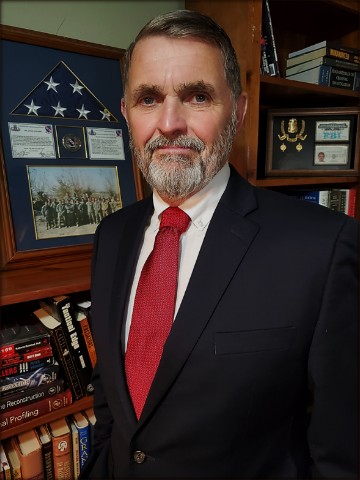 Consultant
Forty years of investigative casework, from patrolman in St. Louis County to the FBI in Chicago, and on to task forces in Afghanistan and Liberia. His work on the Idaho student murders is examined in Broken Plea, the New York Times bestseller by Christopher Whitcomb.
Full profileNever excluded. Professor Gilbertson’s testimony has not been excluded at trial in any state or federal court.
The Hon. Richard A. Jones United States District Judge“Mr. Gilbertson’s qualifications demonstrate extensive experience in policing. His expansive work as a police officer in Georgia, with assignments as a SWAT team officer, juvenile court investigator, school resource officer, stakeout squad officer, senior patrolman, and patrolman; then a career as a tenured college professor and university lecturer teaching criminal justice courses to degree-seeking students at colleges and universities, and as a licensed private investigator conducting felony pretrial investigations for attorneys in Washington State in dozens of criminal cases, makes him unique in the field of police expert witnesses. The Court finds that, based on his experience, Mr. Gilbertson’s testimony can be expected to have a reliable basis in knowledge and experience of police practices.”
A bounded read before the filing decision.
Preliminary case-merit evaluation sits on the practice’s list of engagement forms for a reason: the most expensive practices opinion is the one counsel gets after the complaint is filed. The engagement is a bounded early read of the available record, scoped to a narrower question than a full report answers. Not every question the case will ever raise, but the one that matters now: do the police practices issues in this file support the theory counsel is considering.
Bounded means honest about its own limits. A pre-suit record is a partial record: some categories exist only inside the agency and will not move until discovery. The evaluation works with what is obtainable now, says clearly what is missing, and describes what the missing material could change. That is different from guessing, and the difference is the discipline. Counsel get a map of what is known, what is missing, and what the missing part could prove, which is exactly the posture a filing decision needs.
The boundaries also hold in the usual places. The evaluation is not a legal opinion on which claims to plead: legal conclusions remain counsel’s, and the expert addresses police practices. It is not a valuation of the case, and it predicts no outcomes. What it offers is the practices spine of the filing decision, examined by an expert who has read these records for both sides of the caption since 2014.
In practice the engagement arrives from two directions. Plaintiff’s counsel weighing a civil rights filing use it to test the practices theory before committing the client and the budget to it. Counsel responding to a claim use the same bounded read to gauge exposure before a complaint forces the schedule. Either way the method is identical: the available record, measured against generally accepted police practices, on the totality of the facts and circumstances.
What an early evaluation catches.
Three findings pay for the engagement, and a given evaluation usually returns some mix of all three. Each changes what counsel does next, which is the test an early engagement has to meet: not interesting observations, but decisions made differently.
- Practices issues that are weaker than the footage suggests, caught before the case is built on them.
- Records that must be requested now, while pre-suit channels can still reach them.
- Claims the record genuinely supports, stated with the practices reasoning counsel can build the complaint around.
- The gap list: what cannot be known pre-suit and only discovery will reach, so the uncertainty is priced instead of discovered later.
The first finding deserves the longest look, because it is the one filing pressure hides. Video that looks damning at broadcast speed can sit inside generally accepted police practices when it is run against the full timeline, the agency’s policy, and what the officers knew in the moment. Use-of-force questions are governed by Graham v. Connor, 490 U.S. 386 (1989), and the analysis is anchored to what was known at the time, not to hindsight. An evaluation that applies that discipline pre-suit tells counsel whether the practices case matches the public impression of it before the filing commits the client to the answer.
The second finding is the time-sensitive one. A pre-suit read produces a concrete request list: the incident and investigative reports obtainable through public records channels, the video that exists and where it lives, the involved officers’ complaint history to the extent it is reachable, and the agency policies in force at the time. Some of that material is easiest to get early, and all of it is easier to ask for when an expert has named exactly what the analysis needs.
The third finding is the quiet one: the claims the record does support, and their limits. An individual-conduct theory may be well grounded while a pattern-and-practice theory against the agency is not yet reachable, because training, supervision and discipline records rarely surface pre-suit. Where counsel is weighing a theory under Monell v. Department of Social Services, 436 U.S. 658 (1978), the evaluation can state what the available record shows about the incident itself and name the institutional material discovery would have to produce; the failure to train page covers where those theories go once that material exists.
An early no is cheaper than a late no.
The value of the engagement is the honesty of it. A late no arrives after filing, after months of discovery, after the expert disclosure, sometimes on the eve of dispositive motions, and every dollar and month spent getting there is gone. An early no costs one bounded engagement and a difficult phone call. The arithmetic is lopsided in every direction: the retainer on an early read is small against a case budget, and the months matter more than the money when a limitations date is close. Counsel who have absorbed a late no once rarely skip the early read again.
So the posture is stated up front: if the record does not support the theory, counsel hears it plainly, with the reasons on the record page by page. What if the opinion does not help treats that conversation in full. It is the same candor on every engagement form; the pre-suit version is simply the cheapest place to receive it.
The flip side carries the same weight. When the evaluation comes back supporting the theory, it arrives with the practices reasoning attached, which means the complaint gets drafted against what the record shows rather than what the intake narrative assumed. No outcome is promised in either direction; the deliverable is an honest map, not a forecast. But a filing decision made on a mapped record is a different decision than one made on footage and instinct.
A bounded no is not a verdict on the client’s experience. It is a statement about what the obtainable record supports today, and it names what new material could change the answer.
How the engagement runs, pre-suit.
The evaluation typically runs in a consulting posture, which fits work meant for counsel’s decision-making rather than disclosure. Consulting vs testifying experts covers the distinction and the conversion path; the designation and its consequences under the rules of the eventual forum remain counsel’s call, like every legal question in the file.
The rails are the same as any engagement. A conflict check comes first, before any substantive discussion of the record, and if a conflict exists counsel hears it immediately. Retention runs on the published schedule: a non-refundable $9,000 flat fee covering discovery review and the written expert report, confirmed in writing. Engagements are accepted in plaintiff and defense matters where counsel expects attorney fees to meet or exceed $250,000, and the pre-suit read is often what tells plaintiff’s counsel whether this is such a matter.
What to send is simpler pre-suit than after it. With the first inquiry: the case type and posture, the jurisdiction, any known deadlines such as a limitations date counsel is watching, and the parties for the conflict check, with nothing privileged attached. After retention, the available record travels on physical media, a computer flash drive or external hard drive by mail or courier: the public records production, the incident reports counsel has obtained, the available video from any source, the complaint history, and whatever policy material is already public.
If the evaluation supports filing, the case that follows already has its expert grounding: the record map, the request list, and an analysis that converts to a testifying retention without starting over. When to retain a police practices expert picks up that thread, including the sixty-day report clock the eventual disclosure deadline will impose. The earliest engagement form is also the one that makes every later deadline easier to hit.
Pre-suit calendars carry their own pressure, usually a limitations date counsel is tracking. The evaluation is bounded partly so it can fit inside that pressure: a scoped read of an obtainable record, not a sixty-day report build. The sixty-day clock belongs to the disclosure report that may follow. What the pre-suit read needs is enough runway to obtain the public-records material and read it in order, so counsel watching a near date should say so in the first inquiry, because it shapes what can honestly be evaluated in the time available.
When the question becomes a retention.
This page is reference. When a live matter needs the analysis, these are the doors.
Asked alongside this one.
Can a police practices expert evaluate a case before a lawsuit is filed?
What if the early evaluation says the case is weak?
What should counsel send for a pre-suit merit evaluation?
What does retention cost?
Bring the matter behind the question.
Attorney inquiries are answered directly. If a case presents a conflict, you will hear it immediately.
Inquiry sent.
You will hear back directly. If the matter is urgent, call (239) 571-1840.
Conflicts are checked before any substantive discussion. Please do not send privileged material with a first inquiry; after retention the record is exchanged on physical media. Gregory consults for attorneys and their staff only, and does not provide legal advice or attorney referrals to individuals.