

Supervision and Monell,
term by term.
Direct line: (239) 571-1840 · GregoryGilbertson@proton.me
Attorney and law-firm inquiries only
Twelve terms that recur in municipal liability work, defined as they operate in the record rather than in a brief. The analysis addresses police practices and the documents that show them; whether the legal elements of a claim are met remains counsel’s argument and the court’s ruling.
Three experts. Over 110 years.
Professor Gregory Gilbertson (Ret.), FBI Special Agent Christopher Holland (Ret.), and Sheriff Robert Snaza consult with attorneys nationwide regarding police practices and procedures, use of force, false arrest, police misconduct, criminal, and self-defense casework.
 CEO & Owner
Thirty-eight years in four uniforms: street cop, soldier, professor, investigator. More than 220 matters in 42 states and D.C. since 2014, with testimony that has not been excluded at trial in any state or federal court.
Full biography Consultant
More than thirty-five years in public safety: twelve years and three terms as the elected Sheriff of Lewis County, Washington, and six years a commissioner of the state board that sets peace-officer training standards.
Full profile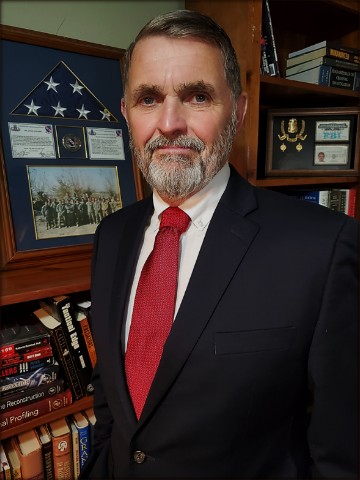 Consultant
Forty years of investigative casework, from patrolman in St. Louis County to the FBI in Chicago, and on to task forces in Afghanistan and Liberia. His work on the Idaho student murders is examined in Broken Plea, the New York Times bestseller by Christopher Whitcomb.
Full profileNever excluded. Professor Gilbertson’s testimony has not been excluded at trial in any state or federal court.
The Hon. Richard A. Jones United States District Judge“Mr. Gilbertson’s qualifications demonstrate extensive experience in policing. His expansive work as a police officer in Georgia, with assignments as a SWAT team officer, juvenile court investigator, school resource officer, stakeout squad officer, senior patrolman, and patrolman; then a career as a tenured college professor and university lecturer teaching criminal justice courses to degree-seeking students at colleges and universities, and as a licensed private investigator conducting felony pretrial investigations for attorneys in Washington State in dozens of criminal cases, makes him unique in the field of police expert witnesses. The Court finds that, based on his experience, Mr. Gilbertson’s testimony can be expected to have a reliable basis in knowledge and experience of police practices.”
The municipal liability vocabulary.
Monell vocabulary gets used loosely, and loose use costs discovery time. The distinctions below decide what counsel requests and what an expert can measure: a policy is a document, a practice is a behavior, and a custom is a behavior the agency stopped correcting. For the request list itself, see the Monell record checklist.
A claim against a municipality or other local government entity under 42 U.S.C. § 1983, taking its name from Monell v. Department of Social Services, 436 U.S. 658 (1978). The theory is organizational rather than personal: the harm must be tied to the entity’s own policy, custom or practice rather than to an employee’s act alone. Police practices analysis supplies the organizational record; whether the legal elements are met is for counsel and the court.
See: Monell claims →The broader label for entity-level exposure of a city, county or agency, of which the Monell theory is the familiar route in civil rights litigation. In practice the phrase signals that the file has to widen: policies across their revisions, training curricula and rosters, complaint and discipline data, supervisory records, and prior similar incidents, rather than the single encounter that started the case.
See: related casework →Three different things that agencies and litigators routinely blur. Policy is what the agency wrote and had in force on the date of the incident. Practice is what officers actually did and what supervisors accepted. Custom is a practice so settled it operates as policy although nobody signed it. The daylight between the three is where organizational analysis lives, documented from policy revisions, training records, reports and discipline files.
See: Policy vs practice →The demanding standard associated with City of Canton v. Harris, 489 U.S. 378 (1989) for claims that an entity’s training or supervision failures caused a constitutional violation. It concerns conscious disregard of an obvious risk, not ordinary negligence. An expert does not declare the standard satisfied. The analysis documents what the agency’s own records put in front of it, what generally accepted practice called for, and what the agency did about it.
See: Monell claims →A course of conduct repeated often enough to read as organizational rather than incidental. In casework the pattern is assembled from complaint histories, prior similar incidents, use-of-force reports, internal affairs dispositions and supervisory reviews, arranged so the repetition is visible on the page. A pattern is shown, not asserted: every instance is cited and dated, and instances that cut the other way are stated as well.
See: related casework →After-the-fact approval of subordinate conduct, and of the basis for it, by an official holding final policymaking authority for the entity on that subject. Who holds that authority is defined by state and local law, and it is frequently narrower than the supervisory chain that reviewed the incident. The documentary trace usually sits in the review chain: the supervisor’s report endorsing the force used, the internal affairs disposition, the absence of corrective action, the return to the same assignment with the same practice intact. Whether that amounts to ratification is a legal question; the analysis shows the review that occurred and how it compared with the agency’s own policy.
See: Internal affairs →Where the organizational theory attaches.
These three theories share a record and differ in where the failure sits: in preparation, in oversight, or in the decision to keep an officer in place. Counsel often pleads more than one. The report keeps them separable so a ruling against one theory does not carry the others with it.
The theory that the agency did not prepare officers for a recurring task the way generally accepted practice requires, that the gap is traceable to the incident, and that the failure rose to deliberate indifference rather than ordinary negligence, which is the threshold Canton sets. The record view is concrete: academy and in-service curricula, lesson plans, what a specific officer actually attended and when, remedial training after prior incidents, and whether the training matched the policy the officer was expected to follow.
See: Training records →The theory that oversight, not instruction, was the missing control: reports approved without being read, force reviews closed without inquiry, conduct visible to a first-line supervisor and never addressed. Supervisory failure is documented through the review artifacts themselves, the approval signatures, the timing of those approvals, and the corrective steps agency policy called for that the file does not show.
See: related casework →Keeping an officer in a position after the agency’s own records showed the risk. Unlike the two theories above, it is ordinarily pleaded as a state law claim, and its elements, its defenses and the immunities available to the agency vary by jurisdiction. The analysis is a chronology built from the personnel and complaint file: the pre-hire background investigation, prior sustained findings, discipline imposed and later rescinded, transfers that followed complaints, and any decertification or National Decertification Index exposure. What duty the agency owed is counsel’s argument; the sequence is the expert’s contribution.
See: related casework →What supervision looks like in the records.
An agency system that flags officers whose complaint, force or vehicle-incident indicators cross a set threshold, so that a supervisor intervenes before the next incident. The litigation questions are whether the agency had one, whether the involved officer triggered it, what it generated, and what a human being did with the alert. The answers matter to both sides, because a documented alert with a documented supervisory response is as much a part of the record as an alert that went nowhere.
See: Early warning systems →The number of officers a single supervisor is responsible for on a shift or at a scene, and the practical ceiling on how much supervision can occur. It matters at two points: in the organizational analysis, where staffing decisions are agency decisions, and at the incident, where the question is whether a supervisor was present, was en route, or was covering more ground than the agency’s own staffing standard contemplates.
See: related casework →The graduated corrective sequence most agencies publish: counseling, retraining, written reprimand, suspension and separation, applied consistently across comparable conduct. Two questions decide its evidentiary value. Did the agency follow the schedule it published, and did comparable conduct by different officers draw comparable outcomes? Inconsistency, documented case by case, is frequently the most persuasive part of a supervision and discipline record.
See: Internal affairs →Supervision records rarely arrive in one production. The early warning systems and supervision guide sets out what to request, and in what order, while discovery is still open.
When the question becomes a retention.
This page is reference. When a live matter needs the analysis, these are the doors.
Asked alongside this one.
What records prove a pattern or practice?
Can an expert say a city was deliberately indifferent?
Bring the matter behind the question.
Attorney inquiries are answered directly. If a case presents a conflict, you will hear it immediately.
Inquiry sent.
You will hear back directly. If the matter is urgent, call (239) 571-1840.
Conflicts are checked before any substantive discussion. Please do not send privileged material with a first inquiry; after retention the record is exchanged on physical media. Gregory consults for attorneys and their staff only, and does not provide legal advice or attorney referrals to individuals.