

What a foot pursuit policy is,
and what it asks before a chase.
Direct line: (239) 571-1840 · GregoryGilbertson@proton.me
Attorney and law-firm inquiries only
A foot pursuit is a decision to chase a person on foot, made alone and at speed, with no supervisor watching and no camera angle that covers all of it. A foot pursuit policy is the agency’s written rule for that decision: when an officer may run, what goes out over the radio, when the chase stops, and what to do instead.
Three experts. Over 110 years.
Professor Gregory Gilbertson (Ret.), FBI Special Agent Christopher Holland (Ret.), and Sheriff Robert Snaza consult with attorneys nationwide regarding police practices and procedures, use of force, false arrest, police misconduct, criminal, and self-defense casework.
 CEO & Owner
Thirty-eight years in four uniforms: street cop, soldier, professor, investigator. More than 220 matters in 42 states and D.C. since 2014.
Full biography Consultant
More than thirty-five years in public safety: Sheriff of Lewis County, Washington, since his election in 2015, and six years as a commissioner of the state board that sets peace-officer training standards.
Full profile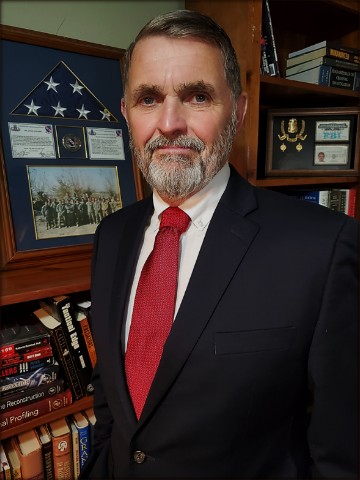 Consultant
Forty years of investigative casework, from patrolman in St. Louis County to the FBI in Chicago, and on to task forces in Afghanistan and Liberia. His work on the Idaho student murders is examined in Broken Plea, the New York Times bestseller by Christopher Whitcomb.
Full profileThe Hon. Richard A. Jones United States District Judge“Mr. Gilbertson’s qualifications demonstrate extensive experience in policing. His expansive work as a police officer in Georgia, with assignments as a SWAT team officer, juvenile court investigator, school resource officer, stakeout squad officer, senior patrolman, and patrolman; then a career as a tenured college professor and university lecturer teaching criminal justice courses to degree-seeking students at colleges and universities, and as a licensed private investigator conducting felony pretrial investigations for attorneys in Washington State in dozens of criminal cases, makes him unique in the field of police expert witnesses. The Court finds that, based on his experience, Mr. Gilbertson’s testimony can be expected to have a reliable basis in knowledge and experience of police practices.”
Why foot pursuits carry their own policy.
Vehicle pursuit policy is a mature subject with its own decision structure, its own supervisory role and its own body of national guidance, treated in pursuit policy standards. A foot pursuit is a different problem. The risk is not principally to uninvolved drivers on a roadway. It falls on the officer, who arrives at the end of the chase alone and winded, separated from the patrol car and the other units, and on the person being chased, who meets that officer at close range with nobody else present and often in a place no camera covered. It falls on bystanders too, in the yards, stairwells and side streets a chase runs through and nobody cleared.
The tactical variables differ as well. A vehicle pursuit is broadcast, tracked and supervised over the air by design. A foot pursuit often begins before anyone has said anything on the radio, ends quickly, and produces a physical encounter at close range with a person who has just been running. A policy written for cars does not answer the questions a foot chase raises, which is why the analysis reads foot pursuit conduct against foot pursuit standards.
Emergency driving and vehicle pursuit questions sit inside pursuits and vehicle operation casework. Foot pursuits usually arrive inside a force case instead, because the force applied at the end of the chase is what brought counsel to the file in the first place.
What model foot pursuit policies address.
National model policies, including those from IACP (International Association of Chiefs of Police) and guidance from PERF (Police Executive Research Forum), treat the foot pursuit as a decision to be structured rather than a tactic to be banned. The structure exists so that an officer who chooses to run is choosing against stated criteria rather than on reflex, and so that someone other than that officer knows the chase is happening.
The decision points a policy is expected to cover.
- The decision to pursue: the offense suspected, the threat presented, and whether the person is already identified
- Communication with dispatch: that a pursuit is underway, the reason for it, the direction of travel, and the description
- Solo pursuits: what an officer alone is expected to do when backup is not close
- Loss of sight or contact with the subject, and what the policy requires from that point
- Containment as an alternative to chasing, including holding a perimeter and waiting for resources
- Force at the end of the pursuit, once the subject stops, is caught or turns
Communication and containment are where the record is usually thinnest. The communication requirement is the one most often missing from the record, and the radio recording shows exactly how much was broadcast and when. Containment is the option a policy can state and training has to make real, since an officer who was never taught to hold a perimeter is more likely to close the distance instead.
The measurement runs against the agency’s own foot pursuit policy in force on the date, then the training that officer received on it, then national guidance, in that order.
How a foot pursuit reads in the record.
A foot pursuit leaves a thinner record than a vehicle pursuit, and the pieces have to be worked together. The radio traffic shows what was broadcast and when. The CAD (computer-aided dispatch) entries fix the units and the times. Body-worn camera supplies a moving, partly obscured view from the chest of a running officer, which is a real limit on what any single frame proves. The officer’s report supplies the reasoning, written afterward.
The analysis begins before the force. By the time force is used at the end of a foot pursuit, a series of tactical decisions has already been made: whether to chase at all, whether to broadcast, whether to close alone or hold and contain. Those are police practices questions with their own standards, and they are examined on their own terms rather than folded into the force decision that followed. What training expects of an officer before any force option is chosen is covered in de-escalation standards. Once the chase ends and force becomes the question, the selection is read the way force options and decision models describes.
A clean foot pursuit is as documentable as a bad one. A foot pursuit that was broadcast, acknowledged and broken off when the policy said to is reported as a foot pursuit run within policy. Where the radio and the camera are both silent on a point the policy turns on, the report says the record does not answer it, and liability remains a legal conclusion for counsel rather than a gap the analysis fills. What a foot pursuit file settles least often is why this person was worth chasing, which is what a policy’s broadcast requirement asks the officer to say on the air while it is still happening.
When the question becomes a retention.
This page is reference. When a live matter needs the analysis, these are the doors.
Asked alongside this one.
What does a police foot pursuit policy require before an officer chases?
Is a foot pursuit policy the same as a vehicle pursuit policy?
What in the record is distinctive to a foot pursuit?
Bring the matter behind the question.
Attorney inquiries are answered directly. If a case presents a conflict, you will hear it immediately.
Inquiry sent.
You will hear back directly. If the matter is urgent, call (239) 571-1840.
Conflicts are checked before any substantive discussion. Please do not send privileged material with a first inquiry; after retention the record is exchanged on physical media. Gregory consults for attorneys and their staff only, and does not provide legal advice or attorney referrals to individuals.