

Juvenile Defense, Read From the First Police Contact
Direct line: (239) 571-1840 · GregoryGilbertson@proton.me
Attorney and law-firm inquiries only
When the accused is a juvenile, a police practices expert for the defense reads the police record in the order it was made: how the young person came to police attention, the circumstances of the questioning and the age the officers knew, whether a parent or guardian was notified, how the warnings were given, and how the interview and the written statement were recorded. Whether any of it meets a legal standard is a question for counsel and the court.
Three experts. Over 110 years.
Professor Gregory Gilbertson (Ret.), FBI Special Agent Christopher Holland (Ret.), and Sheriff Robert Snaza consult with attorneys nationwide regarding police practices and procedures, use of force, false arrest, police misconduct, criminal, and self-defense casework.
 CEO & Owner
Thirty-eight years in four uniforms: street cop, soldier, professor, investigator. More than 220 matters in 42 states and D.C. since 2014.
Full biography Consultant
More than thirty-five years in public safety: Sheriff of Lewis County, Washington, since his election in 2015, and six years as a commissioner of the state board that sets peace-officer training standards.
Full profile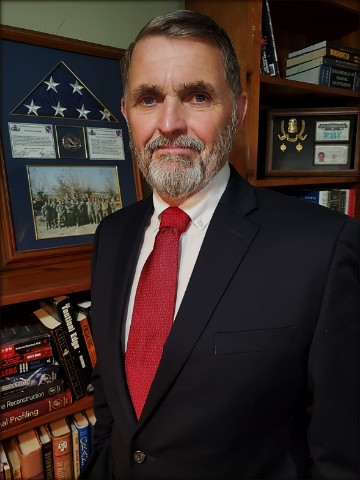 Consultant
Forty years of investigative casework, from patrolman in St. Louis County to the FBI in Chicago, and on to task forces in Afghanistan and Liberia. His work on the Idaho student murders is examined in Broken Plea, the New York Times bestseller by Christopher Whitcomb.
Full profileThe Hon. Richard A. Jones United States District Judge“Mr. Gilbertson’s qualifications demonstrate extensive experience in policing. His expansive work as a police officer in Georgia, with assignments as a SWAT team officer, juvenile court investigator, school resource officer, stakeout squad officer, senior patrolman, and patrolman; then a career as a tenured college professor and university lecturer teaching criminal justice courses to degree-seeking students at colleges and universities, and as a licensed private investigator conducting felony pretrial investigations for attorneys in Washington State in dozens of criminal cases, makes him unique in the field of police expert witnesses. The Court finds that, based on his experience, Mr. Gilbertson’s testimony can be expected to have a reliable basis in knowledge and experience of police practices.”
A juvenile file is read in the order the officers made it.
The police file in a juvenile case holds the kinds of records a criminal file can hold: the dispatch record, the reports, the recordings, the evidence records and any written statement. Where state law or the agency's own directives call for them, it also holds records an adult file does not, such as the notice to a parent or guardian, and the agency's written rules for questioning young people become part of the measure. A police practices expert retained by defense counsel reads that file as police work, from the first contact to the written statement, and measures each step against the agency's directives, the officers' training and generally accepted police practices.
Professor Gilbertson's assignments as a police officer, with the Atlanta Police Department, Zone 3 Precinct, and the LaGrange Police Department, were SWAT team member, senior patrolman, school resource officer, juvenile court investigator, and stakeout squad officer.
Some questions in a juvenile case are not police practices questions, and the analysis does not answer them. Whether the juvenile was in custody, whether a waiver was valid, whether a statement was voluntary and whether any evidence is suppressed are legal questions for counsel and the court. Legal conclusions remain counsel's; the expert addresses police practices.
The first contact fixes what the officers knew, including the juvenile's age.
The record of a juvenile case starts with how the young person came to police attention: a call for service, an officer's observation on patrol, a referral from a school, a tip, or a warrant or court order. The dispatch record, the officer's report and any body-worn camera recording show how the contact began, what the officer was told and what the officer could see, and the analysis reads them for the facts the later steps depend on.
Age is one of those facts. The officers may have learned it from a date of birth in a dispatch entry, a school record or the juvenile's own answer, or it may have been apparent from where and how the contact happened. The record is read for each source and the time it entered the file, because age can bear on the custody question taken up below.
Where an identification procedure followed, a show-up in the field or a photo array later, it is measured as any identification procedure is, against the agency's policy in force at the time and the practices described in photo lineups. The record is also read for whether the fillers fit the description the witness gave, and whether a photograph of the juvenile drawn from a different source than the fillers' photographs stood apart from them. The reliability of any identification is deferred to qualified experts.
Age is part of the custody question when the officers knew it or it was apparent.
Miranda v. Arizona, 384 U.S. 436 (1966), bars the prosecution from using statements that stem from custodial interrogation unless it shows that the procedural safeguards the opinion describes, the warnings among them, were used. The opinion describes custodial interrogation as questioning that officers initiate after a person has been taken into custody or otherwise deprived of freedom of action in a significant way, and whether a juvenile was in custody is a legal question for the court. In J.D.B. v. North Carolina, 564 U.S. 261 (2011), the Supreme Court held that a child's age properly informs that custody analysis, so long as the officer knew the child's age at the time of questioning or it would have been objectively apparent to a reasonable officer. The Court cautioned that age will not be decisive, or even significant, in every case.
That rule makes the record of the questioning a custody record. The analysis reads where the questioning took place and who chose the place; whether the door was closed; how many officers and other adults were present, and who they were; how long the questioning lasted, with its breaks; whether and when the juvenile was told that he or she was free to leave or could decline to answer; and what the juvenile was told about consequences, such as detention. Each circumstance is reported with the record that shows it and its time, and whether together they amount to custody is for the court.
J.D.B. addresses the custody analysis. What state law or the agency's directives required about a parent or guardian is a separate question, taken up next.
The notice to a parent is read for when it was attempted, and what followed.
Where state law or the agency's own directive requires officers to notify a parent or guardian when a juvenile is taken into custody or before questioning begins, the requirement is read from the statute counsel identifies and the directive in force that day. The record is then read against it: who placed the call, to whom, at what time, what was said, and whether the parent asked to be present or was told that questioning would begin. A notice made after the questioning ended is placed after it on the record chronology, not before it. What the statute required, and what follows from a departure from it, are questions for counsel.
A parent's presence or absence is also a fact in the waiver record. In re Gault, 387 U.S. 1 (1967), held that the privilege against self-incrimination applies to juveniles as it does to adults in proceedings to determine whether a juvenile is delinquent, where commitment to a state institution may follow. The Court recognized that special problems may arise with a waiver of the privilege by or on behalf of a child, and that there may be differences in technique, though not in principle, depending on the child's age and the presence and competence of the parents. Where a parent was present, the record is read for when the parent arrived, whether the parent and the juvenile could speak privately before questioning, and what the parent said during it. Where no parent was present, it is read for whether one was asked for, by whom, and what the officers did with the request.
How the warnings reached a juvenile is a record of its own.
Where the questioning was custodial, the warnings and any waiver are read as they were made: the form used, and whether the agency had one written for juveniles; whether each warning was read aloud, and how; whether the juvenile was asked to explain the warnings back, and what the answers were; the time of each step; and whether the waiver was signed, spoken or only implied by the juvenile's continuing to answer. Where a recording exists, it is compared with the form and with the officer's report of the same advisement, and any difference among the three is noted with each source cited.
Whether the juvenile validly waived the rights is a legal question. Fare v. Michael C., 442 U.S. 707 (1979), held that it is decided on the totality of the circumstances, an inquiry that includes the juvenile's age, experience, education, background and intelligence, and whether the juvenile had the capacity to understand the warnings, the nature of the rights and the consequences of waiving them. Fare also held that a juvenile's request to see a probation officer was not by itself an invocation of the rights Miranda protects, and it recognized that where a juvenile's age and experience indicate that a request for a probation officer or a parent was in fact an invocation of the right to remain silent, the totality approach lets the court take that into account. Those determinations belong to the court. The record supplies the facts they rest on: what the juvenile asked for, in what words, at what moment, and how the officers answered.
A juvenile interview is measured by its recording, and the statement by the interview.
The interview is read for how it was run: who conducted it and who else was in the room; how long it lasted, with its breaks; the time of day; whether food, water and rest were offered; what the juvenile was told about the evidence and about what would happen next; and whether anything was promised or threatened. Where the agency's policy required the interview to be recorded, the first question is whether it was, from the opening words to the last.
Where a recording exists beside the officer's summary and the juvenile's written statement, the three are compared. Any place where the summary or the statement adds to, drops or reorders what the recording shows is noted with both sources cited, and so is a written statement whose words the recording shows were the officer's. The method is the one applied to recorded questioning in homicide defense.
The yardstick is the agency's own juvenile directive, where it has one, the interviewer's training and generally accepted practice. The IACP has published a model policy and guidance on interviewing and interrogating juveniles, and national guidance of that kind informs what generally accepted practice includes; the agency's directive is read against it. A departure is reported as a practices finding, and what it means for the voluntariness or admissibility of the statement is a legal question for counsel and the court.
Questioning at school leaves two sets of records, the school's and the agency's.
Where a juvenile is questioned at school, the questioning leaves two sets of records. The school's set can include a discipline referral, an administrator's notes, a visitor log and the school's camera footage; the agency's set includes the dispatch entry, the officer's report and any body-worn camera recording. Read together, they show who began the questioning, whether an administrator, a school resource officer or an investigator who came to the school; whether it began as school discipline and became a police investigation; and when that change came, and who was in the room when it did.
The school setting is part of the custody record. J.D.B. arose from questioning in a closed school conference room after a uniformed officer assigned to the school removed the student from class, and the Court observed that a student, whose attendance is compulsory and whose disobedience is cause for discipline, stands in a far different position at school than an adult visitor does. Where a student was sexually abused or groomed by a teacher, coach, counselor or other school employee, Professor Gilbertson's work on those cases is set out under school sexual abuse cases.
Adolescent development and the law of juvenile court belong to others, on the record.
Some questions in a juvenile case belong to other disciplines, and the report says so where they arise. How adolescents understand warnings, respond to authority and decide under pressure, and whether a particular juvenile's statement is reliable, are questions for qualified experts in developmental psychology, and the research on false confessions belongs to qualified experts in that field. The police practices analysis offers no opinion on them. It supplies, from the record, what the officers did and how it was documented, which those experts and the court can then read.
The procedure of the juvenile court, transfer to adult court and sentencing are questions of law for counsel, and this page does not address them.
A juvenile review can stay consulting-only, as explained in consulting and testifying experts, or lead to a written report and testimony at a suppression hearing, the engagement described under suppression support, or at trial. Written reports require sixty days of advance notice, and retention is a non-refundable $9,000 flat fee covering discovery review and the written expert report; the schedule and terms are at For Counsel.
Juvenile files: what defense counsel asks before sending the record.
Can the analysis say whether a juvenile's confession was false?
What if the juvenile's interview was not recorded?
What if the juvenile was first questioned as a witness?
Does the analysis change when a juvenile is prosecuted in adult court?
What records does a juvenile review need?
Send the juvenile file.
Attorney inquiries are answered directly. If a case presents a conflict, you will hear it immediately.
Inquiry sent.
You will hear back directly. If the matter is urgent, call (239) 571-1840.
Conflicts are checked before any substantive discussion. Please do not send privileged material with a first inquiry; after retention the record is exchanged on physical media. Gregory consults for attorneys and their staff only, and does not provide legal advice or attorney referrals to individuals.